

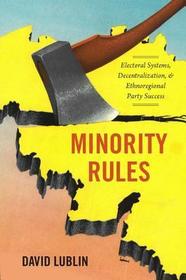
Minority Rules
Electoral Systems, Decentralization, and Ethnoregional Party Success
- Publisher's listprice GBP 43.99
-
19 861 Ft (18 915 Ft + 5% VAT)
The price is estimated because at the time of ordering we do not know what conversion rates will apply to HUF / product currency when the book arrives. In case HUF is weaker, the price increases slightly, in case HUF is stronger, the price goes lower slightly.
- Discount 10% (cc. 1 986 Ft off)
- Discounted price 17 875 Ft (17 024 Ft + 5% VAT)
Subcribe now and take benefit of a favourable price.
Subscribe
19 861 Ft

Availability
printed on demand
Why don't you give exact delivery time?
Delivery time is estimated on our previous experiences. We give estimations only, because we order from outside Hungary, and the delivery time mainly depends on how quickly the publisher supplies the book. Faster or slower deliveries both happen, but we do our best to supply as quickly as possible.
Product details:
- Publisher OUP USA
- Date of Publication 8 January 2015
- ISBN 9780199948840
- Binding Paperback
- No. of pages552 pages
- Size 234x155x38 mm
- Weight 703 g
- Language English 0
Categories
Short description:
In Minority Rules, David Lublin eschews the usual approach of shining attention on conflict and instead looks at the representation of minority groups in largely peaceful and democratic countries throughout the world.
MoreLong description:
When we think of minorities--linguistic, ethnic, religious, regional, or racial--in world politics, conflict is often the first thing that comes to mind. Indeed, discord and tension are the depressing norms in many states across the globe: Iraq, the former Yugoslavia, Sudan, Israel, Sri Lanka, Burma, Rwanda, and many more. But as David Lublin points out in this magisterial survey of minority-based political groups across the globe, such parties typically function fairly well within larger polities. In Minority Rules, he eschews the usual approach of shining attention on conflict and instead looks at the representation of minority groups in largely peaceful and democratic countries throughout the world, from the tiniest nations in Polynesia to great powers like Russia. Specifically, he examines factors behind the electoral success of ethnic and regional parties and, alternatively, their failure to ever coalesce to explain how peaceful democracies manage relations between different groups. Contrary to theories that emphasize sources of minority discontent that exacerbate ethnic cleavages--for instance, disputes over control of natural resource wealth--Minority Rules demonstrates that electoral rules play a dominant role in explaining not just why ethnic and regional parties perform poorly or well but why one potential ethnic cleavage emerges instead of another. This is important because the emergence of ethnic/regional parties along with the failure to incorporate them meaningfully into political systems has long been associated with ethnic conflict. Therefore, Lublin's findings, which derive from an unprecedentedly rich empirical foundation, have important implications not only for reaching successful settlements to such conflicts but also for preventing violent majority-minority conflicts from ever occurring in the first place.
David Lublin offers a titanic effort to pile an in-depth analysis of almost hundred electoral systems, which are helpful to expand the current understanding of how minorities act and react in the democratic game. This is a must-read book, which merits not only the attention of academy, in my personal case it represents one of the best books I have ever read in political science.
Table of Contents:
Dedication
Acknowledgements
Chapter One: Introduction
Part I: Electoral Systems
Chapter Two: Majoritarian Electoral Systems
Chapter Three: Proportional Electoral Systems
Chapter Four: Ni-Ni Electoral Systems
Part II: Electoral Provisions Designed to Assist or to Undermine Ethnoregional Parties
Chapter Five: Communal Lists, Reserved Seats, and Lower Thresholds
Chapter Six: Apportionment and Boundary Delimitation
Chapter Seven: Electoral Provisions Designed to Limit Ethnoregional Parties
Part III: Decentralization
Chapter Eight: Decentralization and Ethnoregional Parties
Chapter Nine: Ethnic Decentralization
Chapter Ten: Non-Ethnic Decentralization and Multivariate Models
Chapter Eleven: Conclusion

