

- Publisher's listprice GBP 120.00
-
54 180 Ft (51 600 Ft + 5% VAT)
The price is estimated because at the time of ordering we do not know what conversion rates will apply to HUF / product currency when the book arrives. In case HUF is weaker, the price increases slightly, in case HUF is stronger, the price goes lower slightly.
- Discount 10% (cc. 5 418 Ft off)
- Discounted price 48 762 Ft (46 440 Ft + 5% VAT)
Subcribe now and take benefit of a favourable price.
Subscribe
54 180 Ft

Availability
printed on demand
Why don't you give exact delivery time?
Delivery time is estimated on our previous experiences. We give estimations only, because we order from outside Hungary, and the delivery time mainly depends on how quickly the publisher supplies the book. Faster or slower deliveries both happen, but we do our best to supply as quickly as possible.
Product details:
- Publisher OUP USA
- Date of Publication 15 March 2012
- ISBN 9780199774142
- Binding Hardback
- No. of pages256 pages
- Size 163x239x17 mm
- Weight 510 g
- Language English 0
Categories
Short description:
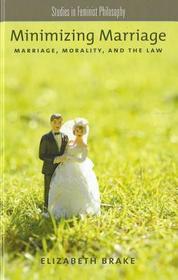
This book addresses fundamental questions about marriage in moral and political philosophy. It examines promise, commitment, care, and contract to argue that marriage is not morally transformative. It argues that marriage discriminates against other forms of caring relationships and that, legally, restrictions on entry should be minimized.
MoreLong description:
Even in secular and civil contexts, marriage retains sacramental connotations. Yet what moral significance does it have? This book examines its morally salient features - promise, commitment, care, and contract - with surprising results. In Part One, "De-Moralizing Marriage," essays on promise and commitment argue that we cannot promise to love and so wedding vows are (mostly) failed promises, and that marriage may be a poor commitment strategy. The book contends with the most influential philosophical accounts of the moral value of marriage to argue that marriage has no inherent moral significance. Further, the special value accorded marriage sustains amatonormative discrimination - discrimination against non-amorous or non-exclusive caring relationships such as friendships, adult care networks, polyamorous groups, or urban tribes. The discussion raises issues of independent interest for the moral philosopher such as the possibilities and bounds of interpersonal moral obligations and the nature of commitment.
The central argument of Part Two, "Democratizing Marriage," is that liberal reasons for recognizing same-sex marriage also require recognition of groups, polyamorists, polygamists, friends, urban tribes, and adult care networks. Political liberalism requires the disestablishment of monogamous amatonormative marriage. Under the constraints of public reason, a liberal state must refrain from basing law solely on moral or religious doctrines; but only such doctrines could furnish reason for restricting marriage to male-female couples or romantic love dyads. Restrictions on marriage should thus be minimized. But public reason can provide a strong rationale for minimal marriage: care, and social supports for care, are a matter of fundamental justice. Part Two also responds to challenges posed by property division on divorce, polygyny, and supporting parenting, and builds on critiques of marriage drawn from feminism, queer theory, and race theory. It argues, using the example of minimal marriage, for the compatibility of liberalism and feminism.
This is an important book, a meticulous, thorough, and innovative work of moral and political philosophy applied to a pressing contemporary dilemma. ... It is one of the most rigorous, comprehensive, and compelling political liberal treatments of the marriage question out there if not the best.
Table of Contents:
Introduction: Marriage and Philosophy
Part One. De-Moralizing Marriage
1. The Marriage Promise: Is Divorce Promise-Breaking?
2. How to Commit Marriage: A Conceptual Guide
3. Marriage, Sex, and Morals
4. Special Treatment for Lovers: Marriage, Care, and Amatonormativity
Part Two: Democratizing Marriage
5. Critiques of Marriage: An Essentially Unjust Institution?
6. Defining Marriage: Political Liberalism and the Same-Sex Marriage Debates
7. Minimizing Marriage: What Political Liberalism Implies for Marriage Law
8. Challenges for Minimal Marriage: Poverty, Property, Polygyny

