

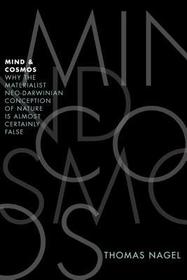
Mind and Cosmos
Why the Materialist Neo-Darwinian Conception of Nature is Almost Certainly False
- Publisher's listprice GBP 32.49
-
15 522 Ft (14 782 Ft + 5% VAT)
The price is estimated because at the time of ordering we do not know what conversion rates will apply to HUF / product currency when the book arrives. In case HUF is weaker, the price increases slightly, in case HUF is stronger, the price goes lower slightly.
- Discount 10% (cc. 1 552 Ft off)
- Discounted price 13 969 Ft (13 304 Ft + 5% VAT)
Subcribe now and take benefit of a favourable price.
Subscribe
15 522 Ft

Availability
printed on demand
Why don't you give exact delivery time?
Delivery time is estimated on our previous experiences. We give estimations only, because we order from outside Hungary, and the delivery time mainly depends on how quickly the publisher supplies the book. Faster or slower deliveries both happen, but we do our best to supply as quickly as possible.
Product details:
- Publisher OUP USA
- Date of Publication 22 November 2012
- ISBN 9780199919758
- Binding Hardback
- No. of pages144 pages
- Size 213x142x17 mm
- Weight 295 g
- Language English 0
Categories
Short description:
In Mind and Cosmos, Thomas Nagel argues that the widely accepted world view of materialist naturalism is untenable. The mind-body problem cannot be confined to the relation between animal minds and animal bodies. If materialism cannot accommodate consciousness and other mind-related aspects of reality, then we must abandon a purely materialist understanding of nature in general, extending to biology, evolutionary theory, and cosmology.
MoreLong description:
In Mind and Cosmos Thomas Nagel argues that the widely accepted world view of materialist naturalism is untenable. The mind-body problem cannot be confined to the relation between animal minds and animal bodies. If materialism cannot accommodate consciousness and other mind-related aspects of reality, then we must abandon a purely materialist understanding of nature in general, extending to biology, evolutionary theory, and cosmology. Since minds are features of biological systems that have developed through evolution, the standard materialist version of evolutionary biology is fundamentally incomplete. And the cosmological history that led to the origin of life and the coming into existence of the conditions for evolution cannot be a merely materialist history. An adequate conception of nature would have to explain the appearance in the universe of materially irreducible conscious minds, as such. No such explanation is available, and the physical sciences, including molecular biology, cannot be expected to provide one. The book explores these problems through a general treatment of the obstacles to reductionism, with more specific application to the phenomena of consciousness, cognition, and value. The conclusion is that physics cannot be the theory of everything.
Mind and Cosmos is ... extraordinarily ambitious. Nagel proposes not merely a new explanation for the origin of life and consciousness, but a new type of explanation: 'natural teleology.'
Table of Contents:
I. Introduction
II. Antireductionism and the Natural Order
III. Consciousness
IV. Cognition
V. Value
VI. Conclusion

