

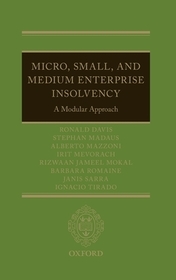
Micro, Small, and Medium Enterprise Insolvency
A Modular Approach
- Publisher's listprice GBP 105.00
-
47 407 Ft (45 150 Ft + 5% VAT)
The price is estimated because at the time of ordering we do not know what conversion rates will apply to HUF / product currency when the book arrives. In case HUF is weaker, the price increases slightly, in case HUF is stronger, the price goes lower slightly.
- Discount 20% (cc. 9 481 Ft off)
- Discounted price 37 926 Ft (36 120 Ft + 5% VAT)
- Discount is valid until: 30 June 2026
Subcribe now and take benefit of a favourable price.
Subscribe
47 407 Ft

Availability
Estimated delivery time: In stock at the publisher, but not at Prospero's office. Delivery time approx. 3-5 weeks.
Not in stock at Prospero.
Why don't you give exact delivery time?
Delivery time is estimated on our previous experiences. We give estimations only, because we order from outside Hungary, and the delivery time mainly depends on how quickly the publisher supplies the book. Faster or slower deliveries both happen, but we do our best to supply as quickly as possible.
Product details:
- Publisher OUP Oxford
- Date of Publication 17 October 2018
- ISBN 9780198799931
- Binding Hardback
- No. of pages256 pages
- Size 242x164x22 mm
- Weight 546 g
- Language English 0
Categories
Short description:
This book reconsiders the treatment of distressed Micro, Small and Medium Enterprises (MSMEs). Recognising that insolvency systems traditionally suit larger enterprises, and that they do not always apply neatly to smaller entities, the book proposes a 'modular' approach designed to facilitate the treatment of smaller enterprises in distress.
MoreLong description:
This new book systematically examines the current process for distressed Micro, Small and Medium Enterprises (MSMEs), and proposes a different, more appropriate, 'modular' approach to the treatment of such entities when faced with insolvency proceedings.
MSMEs play a vital role in virtually all global economies. They are a primary means by which entrepreneurs bring new business propositions to the market, and deliver a range of products and services to local economies. MSMEs tend to be more reliant on favourable legal and regulatory climates to survive and thrive than larger businesses, and insolvency regimes are often more tailored to these larger businesses, assuming an extensive insolvency estate of significant worth, and the presence of creditors and other concerned stakeholders to participate in and oversee the process. These assumptions and features are generally incongruous with the reality of MSMEs, for whom assets are of less value and whose stakeholders are generally more disinterested.
The modular approach proposed in this book addresses the imbalances, inconsistencies, and lack of supervision which is often apparent in treatment of insolvent MSMEs. It provides an overview of existing approaches to MSME insolvency, the place of MSMEs in the global economy, and the particular needs of MSMEs in financial distress. It then sets out the procedural framework, policy objectives, and key components of the modular approach, detailing how a choice of modules enables national policy-makers a more flexible process for resolution. It then outlines the roles, positions, and obligations of key stakeholder groups, and explains the managerial, administrative, and judicial functions of this approach. Finally, it explains how elements of the broader legal system should be aligned with, and supportive of, the optimal functioning of the modular approach.
This is an important book ... It represents the first, concerted effort to address the specific issue of MSME insolvency in a rigorous and scholarly framework, while offering a genuinely practical suggestion for the way forward. The controlling principles of the ground up approach and flexibility anchor the work, while due attention is paid to the incentives needed for a modular approach to work. The book is accessible, clearly written and clearly structured and avoids unnecessary jargon. Thus it is of use for academics, students, policy makers, regulators, international and industry bodies grappling with this important issue.
Table of Contents:
Introduction
MSME Insolvency Status Quo
Principles and Objectives Guiding the Modular Approach to MSME Insolvency
Procedure Under the Modular Approach
Complementary Tools and Incentives
Role and Position of Other Key Stakeholders Interacting with or Affected by the Distressed MSME
Examples for Implementing the Modular Approach beyond specific economic and institutional backgrounds
Conclusion
Annex 1: Introduction of the Modular Approach for MSMEs: A Basic Toolkit for Legal Reform
Annex 2: Lessons from One Jurisdiction on How to Identify Policy Needs of MSME Insolvency
Annex 3: Sample of Questionnaire for Lawyers
Appendix

