

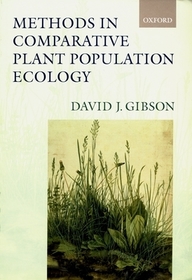
Methods in Comparative Plant Population Ecology
- Publisher's listprice GBP 48.99
-
23 404 Ft (22 290 Ft + 5% VAT)
The price is estimated because at the time of ordering we do not know what conversion rates will apply to HUF / product currency when the book arrives. In case HUF is weaker, the price increases slightly, in case HUF is stronger, the price goes lower slightly.
- Discount 10% (cc. 2 340 Ft off)
- Discounted price 21 064 Ft (20 061 Ft + 5% VAT)
Subcribe now and take benefit of a favourable price.
Subscribe
23 404 Ft

Availability
Out of print
Why don't you give exact delivery time?
Delivery time is estimated on our previous experiences. We give estimations only, because we order from outside Hungary, and the delivery time mainly depends on how quickly the publisher supplies the book. Faster or slower deliveries both happen, but we do our best to supply as quickly as possible.
Product details:
- Publisher Oxford University Press
- Date of Publication 17 January 2002
- ISBN 9780198505624
- Binding Paperback
- No. of pages352 pages
- Size 246x171x18 mm
- Weight 626 g
- Language English
- Illustrations numerous halftones, tables and figures 0
Categories
Short description:
A user-friendly primer on the methodology of plant population ecology research. The book describes what sort of experiments to use, how to design them, and how to interpret, analyse, and report the results. It is designed for enquiry-based courses where students are asked to design and conduct their own experiments.
MoreLong description:
This new book is intended to assist senior undergraduates and post-graduate students design their own experiments and establish a research program in plant population ecology. Practical advice is provided on how to set up a research program, how to ask pertinent questions and use science process skills in conducting research. Individual chapters cover facets of experimental design, statistics, experimental variables and treatments, measurements of plants and their environment, spatial pattern
analysis, life tables, and modelling. Numerous citations to the current research literature are provided, and four case studies are referred to throughout the book to illustrate the use of methodology. The book provides guidance for researchers so that they can critically evaluate the problem they are
addressing, and determine the most suitable approach. The book will be of value to teachers who are developing field and laboratory modules in population ecology.
* A user-friendly primer on the methodology of plant population ecology research.
* Describes what sort of experiments to use, how to design them, and how to interpret, analyse, and report the results.
* Designed for enquiry-based courses where students are asked to design and conduct their own experiments.
A remarkable book! I expect that a whole generation of students will profit immensely from its reading.
Table of Contents:
Part 1: What is plant population ecology?
Scope of plant population ecology
Part 2: Planning a study
The question and approach
Basic considerations in experimental design
Planning, choosing and using statistics
Part 3: Doing the study
Experimental treatments
Measuring individual and population parameters
Abiotic and biotic measurements of a plant's environment
Spatial patterns, life tables and modeling
Appendix: Textbook sources for detailed methods

