

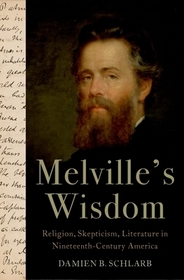
Melville's Wisdom
Religion, Skepticism, and Literature in Nineteenth-Century America
Series: AAR Academy Series;
- Publisher's listprice GBP 74.00
-
35 353 Ft (33 670 Ft + 5% VAT)
The price is estimated because at the time of ordering we do not know what conversion rates will apply to HUF / product currency when the book arrives. In case HUF is weaker, the price increases slightly, in case HUF is stronger, the price goes lower slightly.
- Discount 10% (cc. 3 535 Ft off)
- Discounted price 31 818 Ft (30 303 Ft + 5% VAT)
Subcribe now and take benefit of a favourable price.
Subscribe
35 353 Ft

Availability
Estimated delivery time: Expected time of arrival: end of January 2026.
Not in stock at Prospero.
Why don't you give exact delivery time?
Delivery time is estimated on our previous experiences. We give estimations only, because we order from outside Hungary, and the delivery time mainly depends on how quickly the publisher supplies the book. Faster or slower deliveries both happen, but we do our best to supply as quickly as possible.
Product details:
- Publisher OUP USA
- Date of Publication 12 October 2021
- ISBN 9780197585566
- Binding Hardback
- No. of pages272 pages
- Size 166x244x23 mm
- Weight 553 g
- Language English 203
Categories
Short description:
In Melville's Wisdom: Religion, Skepticism, Literature in Nineteenth-Century America, Damien B. Schlarb explores the manner in which Herman Melville responds to the spiritual crisis of modernity by using the language of the biblical Old Testament wisdom books to moderate contemporary discourses on religion, skepticism, and literature. Schlarb argues that attending to Melville's engagement with the wisdom books (Job, Proverbs, and Ecclesiastes) can help us understand a paradox at the heart of American modernity: the simultaneous displacement and affirmation of biblical language and religious culture.
MoreLong description:
In Melville's Wisdom: Religion, Skepticism, Literature in Nineteenth-Century America, Damien B. Schlarb explores the manner in which Herman Melville responds to the spiritual crisis of modernity by using the language of the biblical Old Testament wisdom books to moderate contemporary discourses on religion, skepticism, and literature. Schlarb argues that attending to Melville's engagement with the wisdom books (Job, Proverbs, and Ecclesiastes) can help us understand a paradox at the heart of American modernity: the simultaneous displacement and affirmation of biblical language and religious culture. In wisdom, which addresses questions of theology, radical skepticism, and the nature of evil, Melville finds an ethos of critical inquiry that allows him to embrace modern analytical techniques, such as higher biblical criticism. In the medium of literature, he articulates a new way of accessing the Bible by marrying the moral and spiritual didacticism of its language with the intellectual distance afforded by critical reflection, a hallmark of modern intellectual style.
Melville's Wisdom joins other works of post secular literary studies in challenging its own discipline's constitutive secularization narrative by rethinking modern, putatively secular cultural formations in terms of their reciprocity with religious concepts and texts. Schlarb foregrounds Melville's sustained, career-spanning concern with biblical wisdom, its formal properties, and its knowledge-creating potential. By excavating this project from his oeuvre, Melville's Wisdom shows how Melville celebrates intellectually rigorous, critical inquisitiveness, an attitude that we often associate with modernity but which Melville saw augured by the wisdom books. He finds in this attitude the means for avoiding the spiritually corrosive effects of skepticism.
It is a rich book filled with astute meditations on the connections between biblical wisdom and Melville's canon that will add a new level of depth and meaning to Melville and 19th century literature. This book would be a welcome addition to a culturally focused 19th century American humanities course and should be embraced in the historiography by Melville scholars.
Table of Contents:
Introduction
Chapter 1 Divine Justice and Sublime Suffering: The Book of Job
A. The Hoary Deep: Multi-perspectival Inquiry in Mardi
B. The Book of Many Jobs: The Literary Representations in Moby-Dick
C. What Job Taught the Lawyer: Moral Didacticism in "Bartleby; the Scrivener"
D. A Potsherd World: Suffering as Topography in The Encantadas
E. Job Critically Regarded: Materialism and Skepticism in The Confidence-Man
F. What to Do with Job
Chapter 2 Dread, Foolishness, Wisdom: The Book of Proverbs
A. Revolutionary Proverbs: Politics and Jurisprudence in Mardi
B. Fear God and the Rod: Religious Rhetoric of Scientism in "The Lightning-Rod Man"
C. The Avatar of Folly: The Battle against Wisdom in Modernity in The Confidence-Man
D. The Problem of Evil: The Reptilian Moderner in Billy Budd; Sailor
E. Melville and Wisdom Aphorisms
Chapter 3 Moderation, Self-Reflection, and Evil: The Book of Ecclesiastes
A. Wisdom as a Guidebook: Truth-Seeking as Way-Finding in Redburn
B. Wisdom as Corrective: Introspection in Moby-Dick
C. Seeking Too Intensely: The Problem of Radical Inquiry in Pierre
D. The Politics of Moderation: The Civil War as Religious Crisis in Battle-Pieces
E. Reflection and Critique in Wisdom
Conclusion: Melville's Wisdom

