

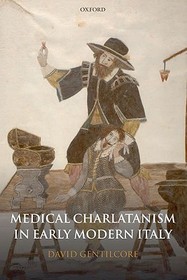
Medical Charlatanism in Early Modern Italy
- Publisher's listprice GBP 187.50
-
84 656 Ft (80 625 Ft + 5% VAT)
The price is estimated because at the time of ordering we do not know what conversion rates will apply to HUF / product currency when the book arrives. In case HUF is weaker, the price increases slightly, in case HUF is stronger, the price goes lower slightly.
- Discount 10% (cc. 8 466 Ft off)
- Discounted price 76 191 Ft (72 563 Ft + 5% VAT)
Subcribe now and take benefit of a favourable price.
Subscribe
84 656 Ft

Availability
printed on demand
Why don't you give exact delivery time?
Delivery time is estimated on our previous experiences. We give estimations only, because we order from outside Hungary, and the delivery time mainly depends on how quickly the publisher supplies the book. Faster or slower deliveries both happen, but we do our best to supply as quickly as possible.
Product details:
- Publisher OUP Oxford
- Date of Publication 21 September 2006
- ISBN 9780199245352
- Binding Hardback
- No. of pages448 pages
- Size 240x165x30 mm
- Weight 852 g
- Language English
- Illustrations 35 half-tones and figures, 5 maps, 4 tables 0
Categories
Short description:
This is an exploration and reconstruction of the role of charlatans, itinerant medical practitioners, in Italy from the Renaissance to the Enlightenment. David Gentilcore examines the goods and services charlatans provided, their marketing strategies, and dealings with the public, and shows how the authorities attempted to regulate and control their business.
MoreLong description:
From the mid-sixteenth century onwards, the Italian Protomedicato tribunals, Colleges of Physicians, or Health Offices (jurisdiction varied from state to state) required charlatans to submit their wares for inspection and, upon approval, pay a licence fee in order to set up a stage from which to perform and sell them. The licensing of charlatans became an administrative routine. As far as the medical magistracies were concerned, charlatans had a defineable identity, constituting a specific trade or occupation.
This book studies the way charlatans were represented, by contemporaries and by historians, how they saw themselves and, most importantly, it reconstructs the place of charlatans in early modern Italy. It explores the goods and services charlatans provided, their dealings with the public and their marketing strategies. It does so from a range of perspectives: social, cultural, economic, political, geographical, biographical and, of course, medical. Charlatans are not just some curiosity on the fringes of medicine: they offered health care to an extraordinarily wide sector of the population. Moreover, from their origins in Renaissance Italy, the Italian ciarlatano was the prototype for itinerant medical practitioners throughout Europe.
This book offers a different look at charlatans. It is the first to take seriously the licences issued to charlatans in the Italian states, compiling them into a 'charlatans database' of over 1,300 charlatans active throughout Italy over the course of some three centuries. In addition, it makes use of other types of archival documents, such as trial records and wills, to give the charlatans a human face, as well as a wide range of artistic and printed sources, not forgetting the output of the charlatans themselves, in the form of handbills and pamphlets.
[A reference point for anyone who wants to study any aspects of medical charlatanism in early modern Europe.
Table of Contents:
Introduction
I: Perspectives
Representations
Self-Presentation
II: Goods and Services
Origins
Licensing
Typology
Materia Medica
Commercial Exchanges and Therapeutic Encounters
III: Communications
Times and Places
Performance
Print
Epilogue
Bibliography
Index

