

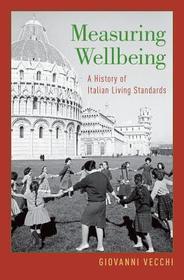
Measuring Wellbeing
A History of Italian Living Standards
- Publisher's listprice GBP 125.00
-
56 437 Ft (53 750 Ft + 5% VAT)
The price is estimated because at the time of ordering we do not know what conversion rates will apply to HUF / product currency when the book arrives. In case HUF is weaker, the price increases slightly, in case HUF is stronger, the price goes lower slightly.
- Discount 20% (cc. 11 287 Ft off)
- Discounted price 45 150 Ft (43 000 Ft + 5% VAT)
- Discount is valid until: 30 June 2026
Subcribe now and take benefit of a favourable price.
Subscribe
56 437 Ft

Availability
Estimated delivery time: In stock at the publisher, but not at Prospero's office. Delivery time approx. 3-5 weeks.
Not in stock at Prospero.
Why don't you give exact delivery time?
Delivery time is estimated on our previous experiences. We give estimations only, because we order from outside Hungary, and the delivery time mainly depends on how quickly the publisher supplies the book. Faster or slower deliveries both happen, but we do our best to supply as quickly as possible.
Product details:
- Publisher OUP USA
- Date of Publication 9 March 2017
- ISBN 9780199944590
- Binding Hardback
- No. of pages672 pages
- Size 239x160x38 mm
- Weight 1270 g
- Language English 0
Categories
Short description:
The book recounts the evolution of the wellbeing of the Italians - from rags to riches - over the last hundred and fifty years. Giovanni Vecchi blends economic ideas with newly-constructed historical statistics on a footing which accounts for the historical context.
MoreLong description:
Italy - born as one nation on March 17, 1861 - was a poor and backward country in the most Southern part of Europe. Most Italians lived a short and troubled life, with little prospect of giving their children a better future. That was how it had been for centuries in the Italian peninsula. In one and half centuries, the Italians astonished us by turning Italy into a country where living standards are among the highest in the world. The Dolce Vita found its home in Italy. How did such a transformation come about? The book provides an answer based on an impressive volume of newly-constructed historical statistics, and does so aided by an easilyt accessible and enjoyable narrative.
In more than 20 years of research, Giovanni Vecchi has gathered tens of thousands of family accounts, so that the themes of economic inequality, poverty and vulnerability can at last be placed at the centre of the book. This history is written from the bottom up, starting with the elementary data, those coming from the lives of individuals and households. Measuring Wellbeing builds up the "macro" picture (the history) from the "micro" data (the stories).
The concept of wellbeing is, by its very nature, multidimensional and must therefore include the non-monetary aspects of life: nutrition, health and education, but also less tangible elements such as freedom or the possibility to exercise one's political rights. The book deals with this polyhedral nature of wellbeing using a uniform method. Great effort has been taken not to exercise the reader with technical details, but tables and graphs have nevertheless been included because they are decisive tools for readers to gain insight and keep up their guard against the fallacy of what at first sight may seem to be incontrovertible.
This is an important book for Italians, and it makes a remarkable contribution to the description of the long-term evolution of standards of living in Italy.
Table of Contents:
Chapter 1 - Nutrition
Chapter 2 - Height
Chapter 3 - Health
Chapter 4 - Child Labour
Chapter 5 - Education
Chapter 6 - Migration
Chapter 7 - Income
Chapter 8 - Inequality
Chapter 9 - Poverty
Chapter 10 - Wealth
Chapter 11 - Vulnerability
Chapter 12 - Human Development
Chapter 13 - Household Budgets
Chapter 14 - Cost of Living

