

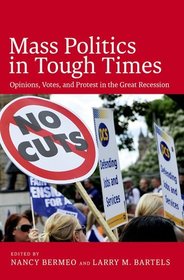
Mass Politics in Tough Times
Opinions, Votes and Protest in the Great Recession
- Publisher's listprice GBP 45.99
-
20 764 Ft (19 775 Ft + 5% VAT)
The price is estimated because at the time of ordering we do not know what conversion rates will apply to HUF / product currency when the book arrives. In case HUF is weaker, the price increases slightly, in case HUF is stronger, the price goes lower slightly.
- Discount 10% (cc. 2 077 Ft off)
- Discounted price 18 687 Ft (17 798 Ft + 5% VAT)
Subcribe now and take benefit of a favourable price.
Subscribe
20 764 Ft

Availability
printed on demand
Why don't you give exact delivery time?
Delivery time is estimated on our previous experiences. We give estimations only, because we order from outside Hungary, and the delivery time mainly depends on how quickly the publisher supplies the book. Faster or slower deliveries both happen, but we do our best to supply as quickly as possible.
Product details:
- Publisher OUP USA
- Date of Publication 27 February 2014
- ISBN 9780199357512
- Binding Paperback
- No. of pages400 pages
- Size 229x155x27 mm
- Weight 522 g
- Language English
- Illustrations 65 b&w line; 44 tables 0
Categories
Short description:
In Mass Politics in Tough Times, the eminent political scientists Larry Bartels and Nancy Bermeo have gathered a group of leading scholars to analyze the political responses to the Great Recession in the US, Western Europe, and East-Central Europe.
MoreLong description:
The impact of the Great Depression on politics in the 1930s was both transformative and shocking. The role of government in America was forever transformed, and across Europe socialist, communist, and fascist parties saw their support skyrocket. Most famously, the National Socialists seized power in Germany in 1933, setting off a chain of events that led to the greatest conflagration in world history. The recent Great Recession has not been as severe as the Great Recession, but it has been severe enough, producing a half decade of negative and/or slow growth across the advanced industrial world. Yet the response by voters has been extraordinarily muted considering the circumstances. Why is this?
In Mass Politics in Tough Times, the eminent political scientists Larry Bartels and Nancy Bermeo have gathered a group of leading scholars to analyze the political responses to the Great Recession in the US, Western Europe, and East-Central Europe. In contrast to works that focus on policy responses to the Recession, they examine how ordinary voters have responded. In almost every country, most voters have not shifted their allegiance to either far left or far right parties. Instead, they've continued to act as they have in more normal times: vote based on their own personal circumstances and punish the incumbents who were on watch when the bad turn occurred regardless of whether they were center-left or center-right. In some countries, electoral trends that existed before the Recession have continued. The US, for instance, saw no real increase in popular support for an expanded welfare state. In fact, the anti-regulatory right, which gained strength before the Recession occurred, experienced a series of victories in Wisconsin after 2008. Interestingly, states that had strong welfare systems have seen the least political realignment. As the contributors show, ordinary voters tend to vote based on their own experiences, and those in expansive welfare states have been buffered from the harshest effects of the Recession. That said, states with weaker welfare systems--e.g., Greece--have seen significant political turmoil. Moreover, there have been a small number of cases of popular radicalization, and the contributors have been able to isolate the cause: when voters can establish a clear and direct connection between the actions of political elites and economic hardship, they will throw their support to protest parties on the right and left. Ultimately, though, the picture is one of relatively stoic acceptance of the downturn by the majority of publics. Featuring an impressive range of cases, this will stand as the most comprehensive scholarly account of the Great Recession's impact on political behavior in advanced economies.
Table of Contents:
About the Contributors
Chapter 1: Mass Politics in Tough Times
Nancy Bermeo and Larry M. Bartels
Chapter 2: Crisis of Confidence?: The Dynamics of Economic Opinions during the Great Recession
Christopher J. Anderson and Jason D. Hecht
Chapter 3: Political Understanding of Economic Crises:: The Shape of Resentment toward Public Employees
Katherine Cramer Walsh
Chapter 4: Economic Crisis and Support for Redistribution in the United Kingdom
Stuart Soroka and Christopher Wlezien
Chapter 5: Economic Insecurity and Public Support for the Euro: Before and During the Financial Crisis
Sara B. Hobolt and Patrick Leblond
Chapter 6:Attitudes toward Immigration in Good Times and Bad
Rafaela Dancygier and Michael Donnelly
Chapter 7: Ideology and Retrospection in Electoral Responses to the Great Recession
Larry M. Bartels
Chapter 8: Crisis Perceptions and Economic Voting Among the Rich and the Poor:
The United Kingdom and Germany
Raymond M. Duch and Iñaki Sagarzazu
Chapter 9: The Electoral Impact of the Crisis on the French Working Class:
More to the Right?
Nonna Mayer
Chapter 10: The Political Consequences of the Economic Crisis in Europe:
Electoral Punishment and Popular Protest
Hanspeter Kriesi
An End to "Patience"?: The Great Recession and Economic Protest in Eastern EuropeMark R. Beissinger and Gwendolyn Sasse

