

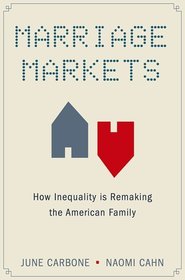
Marriage Markets
How Inequality is Remaking the American Family
- Publisher's listprice GBP 36.49
-
17 433 Ft (16 602 Ft + 5% VAT)
The price is estimated because at the time of ordering we do not know what conversion rates will apply to HUF / product currency when the book arrives. In case HUF is weaker, the price increases slightly, in case HUF is stronger, the price goes lower slightly.
- Discount 10% (cc. 1 743 Ft off)
- Discounted price 15 689 Ft (14 942 Ft + 5% VAT)
Subcribe now and take benefit of a favourable price.
Subscribe
17 433 Ft

Availability
printed on demand
Why don't you give exact delivery time?
Delivery time is estimated on our previous experiences. We give estimations only, because we order from outside Hungary, and the delivery time mainly depends on how quickly the publisher supplies the book. Faster or slower deliveries both happen, but we do our best to supply as quickly as possible.
Product details:
- Publisher OUP USA
- Date of Publication 29 May 2014
- ISBN 9780199916580
- Binding Hardback
- No. of pages272 pages
- Size 165x239x22 mm
- Weight 530 g
- Language English 0
Categories
Short description:
In this rigorous and enlightening account of why American families have transformed so much since the 1960s, two leading scholars of family law argue that the changing economy, rather than changing morals, is at the root of family instability.
MoreLong description:
Over the past four decades, the American family has undergone a radical transformation. Skyrocketing rates of divorce, single parenthood, and couples with children out of wedlock have all worked to undermine an idealized family model that took root in the 1950s and has served as a beacon for traditionalists ever since. But what are the causes of this change? Conservatives blame it on moral decline and women's liberation. Progressives often attribute it to women's greater freedom and changing sexual mores, but they typically paint these trends in a positive light. In Family Classes, Naomi Cahn and June Carbone contend that these views miss the forest for the trees. Armed with authoritative evidence, they show that the changing structure of our economy is the root cause of the transformation, and that working class and poorer families have paid the highest price. Increasing inequality and instability in the labor market over the past three decades has had a disproportionately negative impact on family stability and marriage rates among working-class and lower-income Americans. In particular, the decline of stable blue collar jobs for men has upended the labor market in the lower deciles of the income chart. Conversely, educated middle class Americans now have the highest rates of both marriage and marital stability despite the fact that they are relatively unlikely to espouse 'traditional values.' In fact, their family stability rate appears to be increasing. That is important because the children of stable two-parent families really do have a leg up in life.
They draw from truly fascinating sociological data to drive home their point that economic factors weigh heaviest. For instance, when eligible (i.e., desirable and marriageable) men outnumber eligible women, the marriage and marital stability rates are significantly higher than when the reverse situation occurs - the exact situation we have in America today. Among the educated middle classes, eligible men outnumber eligible women in the area that truly matters--high incomes--and people in that strata therefore have far more stable family lives than working class and poorer Americans. In these latter sectors, men have lost economic ground vis-à-vis women, and family lives have become increasingly unstable in the last two decades. Interestingly, religion and moral values are insignificant factors in generating this difference in comparison to class. To make families stronger, then, we need to increase the level of economic stability in the bottom half of the population. The authors close with a series of policy proposals to address the family-related problems that flow from economic instability. A rigorous and enlightening account of why American families have changed so much since the 1960s, Family Classes cuts through the ideological and moralistic rhetoric that drives our current debate.
In easy-to-read prose, the authors also show how divorce courts erect barriers between poor dads and their children, while expanding the rights of rich dads. Changing attitudes about marriage require overhauling family law to both strengthen unions while ending the presumption that marriage is best for rearing children.
Table of Contents:
Introduction
Section I: The Puzzles of Today's Families
Chapter 1: Changing Families
Chapter 2: The New Foundations for Family Life: The Disappearance of the Center and the Emergence of Marriage As a Marker of Class
Chapter 3: Not Blaming the Victim: Derailed by Moynihan
Chapter 4: Blaming the Victim: The Morality Tale
Chapter 5: Getting Closer: The Rediscovery of Marriage Markets
Section II: The New Terms
Chapter 6: The Heart of the Matter
Chapter 7: Where the Men Are
Chapter 8: Remaking Class Barriers: Children and Achievement
Chapter 9: The Recreation of Class
Section III Legalizing Inequality: The Class Divide in the Meaning of Family Law
Chapter 10: The Law: Rewriting the Marital Script
Chapter 11: Shared Parenting: Egalitarian, Patriarchal or Both?
Section IV Rebuilding Community: Inequality, Class, and Family
Chapter 12: Rebuilding From the Top Down: The Family, Inequality and Employment
Chapter 13: Rebuilding from the Bottom up: Addressing Children's Needs.
Chapter 14: Sex, Power, Patriarchy and Parental Obligation
Chapter 15: The Rebirth of Community and the Family

