

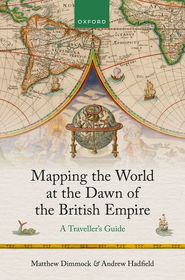
Mapping the World at the Dawn of the British Empire
A Traveller's Guide
- Publisher's listprice GBP 25.00
-
11 287 Ft (10 750 Ft + 5% VAT)
The price is estimated because at the time of ordering we do not know what conversion rates will apply to HUF / product currency when the book arrives. In case HUF is weaker, the price increases slightly, in case HUF is stronger, the price goes lower slightly.
- Discount 10% (cc. 1 128 Ft off)
- Discounted price 10 159 Ft (9 675 Ft + 5% VAT)
Subcribe now and take benefit of a favourable price.
Subscribe
11 287 Ft

Availability
Estimated delivery time: In stock at the publisher, but not at Prospero's office. Delivery time approx. 3-5 weeks.
Not in stock at Prospero.
Why don't you give exact delivery time?
Delivery time is estimated on our previous experiences. We give estimations only, because we order from outside Hungary, and the delivery time mainly depends on how quickly the publisher supplies the book. Faster or slower deliveries both happen, but we do our best to supply as quickly as possible.
Product details:
- Publisher OUP Oxford
- Date of Publication 17 July 2025
- ISBN 9780198942511
- Binding Hardback
- No. of pages240 pages
- Size 240x160x15 mm
- Weight 537 g
- Language English
- Illustrations 35 Illustrations 714
Categories
Short description:
A compact and informative guide to the ways in which the changing world of the early seventeenth century was understood and experienced by the British before the British Empire was established.
MoreLong description:
Mapping the World at the Dawn of the British Empire is a compact and informative guide to the ways in which the world was understood and imagined by British travellers and readers in the Tudor and Jacobean period, just before the rapid expansion of the transoceanic British Empire from the mid-seventeenth century onwards.
The book shows how the relatively restricted English-speaking world understood different people and places, sometimes through direct encounters, more often through descriptions and travel narratives. The book covers British perceptions of the diverse cultures of the world known to them in the early seventeenth century, from Paris to the South Sea Islands; from the earliest precarious colonies established in the Americas to the mighty Ottoman and Chinese empires; from the frozen north as sailors vainly sought to open up new trade routes by discovering the north-west or north-east passages, to the arid deserts of the Sahara; from the rich fishing grounds of the Baltic and the North Atlantic to the mythical kingdom of Prester John, the fabled golden city of El Dorado and the hidden societies of the dangerous women warriors, the Amazons. The book shows that British readers encountered a vision of the world that simultaneously represented them as specially selected white Christians, superior to other peoples, but also reminded them how dependent they were on other peoples, whose territories produced such vast riches.
Reading these accounts of travel, trade, and colonialism demonstrates that English speakers realized how much they had to learn if their nations were to survive and flourish, as well as the possibilities for accumulating wealth through trade and conquest. The book is divided into six chapters, each prefaced by a contemporary map: Europe, The North, Islamic West Asia and the Eastern Mediterranean, East Asia and the South Seas, Africa, and The Americas. There is an introduction, a conclusion, a bibliographical essay, and a guide explaining how to use the book. There are also 35 illustrations, comprising of maps, portraits, and images of relevant objects discussed in the text.
[readers] are invited into an immersive and intellectually stimulating reading experience, imagining themselves as travellers through both time and space. With its engaging style, clear expression and well-paced structure, the book proves to be an ideal guide and introductory textbook for students of the early modern period seeking a general understanding of the topic.
Table of Contents:
Introduction: The Great Globe
Europe
The north
Africa
Islamic West Asia and the eastern Mediterranean
East Asia and the South Seas
The Americas
Conclusion: Barbados

