

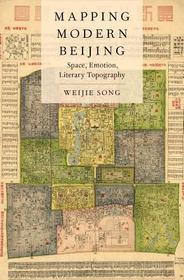
Mapping Modern Beijing
Space, Emotion, Literary Topography
- Publisher's listprice GBP 88.00
-
39 732 Ft (37 840 Ft + 5% VAT)
The price is estimated because at the time of ordering we do not know what conversion rates will apply to HUF / product currency when the book arrives. In case HUF is weaker, the price increases slightly, in case HUF is stronger, the price goes lower slightly.
- Discount 10% (cc. 3 973 Ft off)
- Discounted price 35 759 Ft (34 056 Ft + 5% VAT)
Subcribe now and take benefit of a favourable price.
Subscribe
39 732 Ft

Availability
printed on demand
Why don't you give exact delivery time?
Delivery time is estimated on our previous experiences. We give estimations only, because we order from outside Hungary, and the delivery time mainly depends on how quickly the publisher supplies the book. Faster or slower deliveries both happen, but we do our best to supply as quickly as possible.
Product details:
- Publisher OUP USA
- Date of Publication 29 March 2018
- ISBN 9780190200671
- Binding Hardback
- No. of pages320 pages
- Size 163x239x27 mm
- Weight 567 g
- Language English
- Illustrations 10 halftones 0
Categories
Short description:
Mapping Modern Beijing investigates various modes of representing Beijing by writers travelling across mainland China, Taiwan, Hong Kong, and overseas Sinophone and non-Chinese communities.
MoreLong description:
"I have lived in Beijing for thirty years, but I can't say that I have yet comprehended this city," wrote Lao Xiang, the great Chinese novelist, in 1935. Mapping Modern Beijing explores the various ways novelists sought to understand and articulate China's second largest city in the first half of twentieth century. Song investigates five modes of representing Beijing: as a warped hometown, a city of snapshots and manners, an aesthetic city, an imperial capital in comparative and cross-cultural perspective, and a displaced city on the Sinophone and diasporic postmemory. Drawing from literary canons to exotic narratives, from modernist poetry to chivalric fantasy, from popular culture to urban planning, this book explores the complex nexus of urban spaces, archives of emotions, and literary topography of Beijing in its long journey from imperial capital to Republican city and to socialist metropolis. While most English-language literary studies of China focus on its rural locales, Song's study presents a welcome departure, expanding our understandings of Chinese literature into the urban and the modern.
"[Weijie Song] is engaging brilliantly in what I would call spatial reading... this book is of great value to the evolving study of modern and contemporary Chinese culture, particularly in responding to recent emphases on global and cosmopolitan perspectives and intercultural interactions, but also in creating a context in which to showcase major cultural figures who have not necessarily gotten the attention they deserve.
Table of Contents:
Acknowledgments
Introduction
Chapter 1: A Warped Hometown: Lao She and Beijing Complex
Chapter 2: Urban Snapshots and Manners: Zhang Henshui and Beijing Dream
Chapter 3: The Aesthetic versus the Political: Lin Huiyin and the City
Chapter 4: A Comparative Imperial Capital: Lin Yutang, Princess Der Ling, Victor Segalen, and Views from Near and Afar
Chapter 5: A Displaced City and Postmemory: Relocating Beijing in Sinophone Writing
Epilogue
Selected Bibliography
Index

