

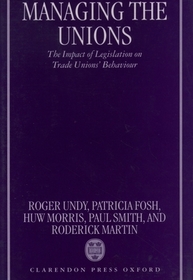
Managing the Unions
The Impact of Legislation on Trade Unions' Behaviour
- Publisher's listprice GBP 54.00
-
24 381 Ft (23 220 Ft + 5% VAT)
The price is estimated because at the time of ordering we do not know what conversion rates will apply to HUF / product currency when the book arrives. In case HUF is weaker, the price increases slightly, in case HUF is stronger, the price goes lower slightly.
- Discount 10% (cc. 2 438 Ft off)
- Discounted price 21 943 Ft (20 898 Ft + 5% VAT)
Subcribe now and take benefit of a favourable price.
Subscribe
24 381 Ft

Availability
printed on demand
Why don't you give exact delivery time?
Delivery time is estimated on our previous experiences. We give estimations only, because we order from outside Hungary, and the delivery time mainly depends on how quickly the publisher supplies the book. Faster or slower deliveries both happen, but we do our best to supply as quickly as possible.
Product details:
- Publisher OUP Oxford
- Date of Publication 13 June 1996
- ISBN 9780198289197
- Binding Hardback
- No. of pages336 pages
- Size 241x162x24 mm
- Weight 643 g
- Language English
- Illustrations line figures, tables 0
Categories
Short description:
This book examines in detail the industrial relations and employment legislation introduced by the Conservative government and its impact on trade unions - their role, organization, influences and prospects. In particular it looks at the use of ballot legislation as an instrument in this process. It will be essential reading for anyonw who wishes to understand how the changing framework of labour relations has affected union behaviour.
MoreLong description:
One of the major intentions of the Conservative governments of the 1980s was to redraw the landscape and map of industrial relations. They aimed to achieve this through a combination of measures: political initiatives and campaigning; a changed economic and social environment; and most directly a programme of industrial relations legislation that increasingly curtailed the role and influence of trade union.
This book examines the policies and associated legislation directly intended to change union behaviour. It considers origins, purpose and impact on union behaviour and structure, focusing on the role of ballots as the central mechanism chosen for changing union decision-making. The changes that occurred as a consequence of this legislation are placed in the wider union context and the relative influence of the balloting legislation is assessed against other developments affecting union behaviour, including the strategies adopted by the unions' leaders. It finds the results were not always as intended by the Conservative governments.
In a concluding chapter the authors ask whether the framework created in the UK will be an exemplar or exceptional case when compared with developments in other European countries.
The book itself is the result of research carried out over almost a decade by a highly experienced and respected team who base their analysis on interviews, detailed analysis of legislation and union rule books, and a series of in-depth case studies.
This richly detailed and authoritative book will be essential reading for anyone who wishes to understand how the changing framework of labour relations affected changes in union behaviour. the book will thus appeal to students and academics working in industrial relations, human resource management, labour law, labour economics and politics. Employee relations practitioners and policy makers - managers and trade unionists - will also find it useful for increasing their understanding of the purpose and effect of the legislation.
The first comprehensive study of the effect of Conservative anti-union legislation.

