

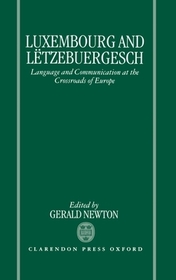
Luxembourg and Lëtzebuergesch
Language and Communication at the Crossroads of Europe
- Publisher's listprice GBP 78.00
-
35 217 Ft (33 540 Ft + 5% VAT)
The price is estimated because at the time of ordering we do not know what conversion rates will apply to HUF / product currency when the book arrives. In case HUF is weaker, the price increases slightly, in case HUF is stronger, the price goes lower slightly.
- Discount 10% (cc. 3 522 Ft off)
- Discounted price 31 695 Ft (30 186 Ft + 5% VAT)
Subcribe now and take benefit of a favourable price.
Subscribe
35 217 Ft

Availability
printed on demand
Why don't you give exact delivery time?
Delivery time is estimated on our previous experiences. We give estimations only, because we order from outside Hungary, and the delivery time mainly depends on how quickly the publisher supplies the book. Faster or slower deliveries both happen, but we do our best to supply as quickly as possible.
Product details:
- Publisher Clarendon Press
- Date of Publication 21 March 1996
- ISBN 9780198240167
- Binding Hardback
- No. of pages304 pages
- Size 221x145x23 mm
- Weight 488 g
- Language English
- Illustrations line figures, maps, tables 0
Categories
Short description:
This is a specially commissioned collection focusing on Luxembourg and its national language, Lëtzebuergesch. The contributors look at patterns of linguistic communication involving French, German, and English as well as Lëtzebuergesch in a nation which is at one and the same time at the heart of the European Union and a very private and close-knit small-scale community. The book contains the first extended description of Lëtzebuergesch in English.
MoreLong description:
The Grand Duchy of Luxembourg sits at the heart of the European Union, yet it forms a very private and close-knit community. The book addresses that apparent paradox, and shows how it is reflected in and sustained by the linguistic practices of the people who live there, both native and foreign. Letzebuergesch, the country's national language, is most closely related to the German dialects of the western Rhineland and the Moselle river valley, but the country's historical and cultural links with Belgium, the Netherlands, and France are much closer than with Germany. Since the demise of Latin in the late Middle Ages as the language of administration, that role has been filled at various times by the standard varieties of French and German. Declared a protected neutral country in 1867, Luxembourg has been twice invaded by Germany in the twentieth century. But since 1945 French and Letzebuergesch have come to predominate and the use of German has once again receded. It is the unwritten social code governing the use of these languages (and latterly also of English) which gives this volume of specially commissioned papers its focus: the purpose is to provide an insider's view of the community, and of its little-known language. The book contains the most detailed linguistic description of Letzebuergesch so far available in English.
The book is comprpehensive, well-ordered, and written in clear intelligible diction throughout. It is to be hoped that it will contribute to a better understanding of Luxemburgers and their language throughout the English-speaking world.

