

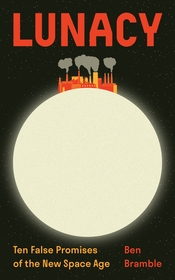
Lunacy
Ten False Promises of the New Space Age
- Publisher's listprice GBP 15.99
-
7 219 Ft (6 875 Ft + 5% VAT)
The price is estimated because at the time of ordering we do not know what conversion rates will apply to HUF / product currency when the book arrives. In case HUF is weaker, the price increases slightly, in case HUF is stronger, the price goes lower slightly.
- Discount 10% (cc. 722 Ft off)
- Discounted price 6 497 Ft (6 188 Ft + 5% VAT)
Subcribe now and take benefit of a favourable price.
Subscribe
7 219 Ft

Availability
Not yet published.
Why don't you give exact delivery time?
Delivery time is estimated on our previous experiences. We give estimations only, because we order from outside Hungary, and the delivery time mainly depends on how quickly the publisher supplies the book. Faster or slower deliveries both happen, but we do our best to supply as quickly as possible.
Product details:
- Publisher Princeton University Press
- Date of Publication 14 July 2026
- Number of Volumes Print PDF
- ISBN 9780691281285
- Binding Paperback
- No. of pages200 pages
- Size 203x127 mm
- Language English 700
Categories
Long description:
Why we shouldn’t colonize Mars or the Moon, or even vacation there
If certain business titans, corporations, and governments have their way, humans will someday be living, working, and vacationing in space. This is the much-vaunted New Space Age, and in Lunacy, philosopher Ben Bramble explains why it is a giant mistake. Bramble systematically refutes each of the ten most influential reasons given for this new generation of space exploration (and habitation), from the idea of Mars as a backup plan in case Earth meets an untimely end to the charms of friendship with extraterrestrials. Doing so, he reflects on deeper issues, exploring such questions as what the point of the human story is and what a good future for humanity would truly involve. (Spoiler alert: it includes solving problems on Earth.)
Bramble does not think we should get out of space entirely. On the contrary, he thinks that there is an important and exciting future in space science. Our activities in space, he tells us, should be animated by a curiosity about space itself rather than narrow economic or military interests.

