

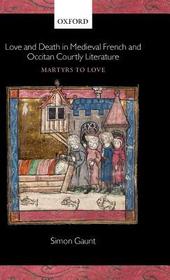
Love and Death in Medieval French and Occitan Courtly Literature
Martyrs to Love
- Publisher's listprice GBP 177.50
-
80 141 Ft (76 325 Ft + 5% VAT)
The price is estimated because at the time of ordering we do not know what conversion rates will apply to HUF / product currency when the book arrives. In case HUF is weaker, the price increases slightly, in case HUF is stronger, the price goes lower slightly.
- Discount 10% (cc. 8 014 Ft off)
- Discounted price 72 127 Ft (68 693 Ft + 5% VAT)
Subcribe now and take benefit of a favourable price.
Subscribe
80 141 Ft

Availability
printed on demand
Why don't you give exact delivery time?
Delivery time is estimated on our previous experiences. We give estimations only, because we order from outside Hungary, and the delivery time mainly depends on how quickly the publisher supplies the book. Faster or slower deliveries both happen, but we do our best to supply as quickly as possible.
Product details:
- Publisher OUP Oxford
- Date of Publication 16 February 2006
- ISBN 9780199272075
- Binding Hardback
- No. of pages248 pages
- Size 223x145x20 mm
- Weight 429 g
- Language English
- Illustrations 1 black and white illustration 0
Categories
Short description:
Examines the association of love and death in medieval French and Occitan courtly literature using an approach informed by Lacanian psychoanalysis and Jacques Derrida. Offers new readings of canonical authors and texts, including Bernart de Ventadorn, Jaufre Rudel, Chrétien de Troyes, Thomas's Tristan, the Prose Lancelot, the Tristan en prose, La Mort le roi Artu, Marie de France, Le Chastelaine de Vergy, Le Castelain de Couci, and Le Roman de la Rose.
MoreLong description:
Some of medieval culture's most arresting images and stories inextricably associate love and death. Thus the troubadour Jaufre Rudel dies in the arms of the countess of Tripoli, having loved her from afar without ever having seen her. Or in Marie de France's Chevrefoil, Tristan and Iseult's fatal love is hauntingly symbolized by the fatally entwined honeysuckle and hazel. And who could forget the ethereal spectacle of the Damoisele of Escalot's body carried to Camelot on a supernatural funerary boat with a letter on her breast explaining how her unrequited love for Lancelot killed her? Medieval literature is fascinated with the idea that love may be a fatal affliction. Indeed, it is frequently suggested that true love requires sacrifice, that you must be ready to die for, from, and in love. Love, in other words, is represented, sometimes explicitly, as a form of martyrdom, a notion that is repeatedly reinforced by courtly literature's borrowing of religious vocabulary and imagery. The paradigm of the martyr to love has of course remained compelling in the early modern and modern period.
This book seeks to explore what is at stake in medieval literature's preoccupation with love's martyrdom. Informed by modern theoretical approaches, particularly Lacanian psychoanalysis and Jacques Derrida's work on ethics, it offers new readings of a wide range of French and Occitan courtly texts from the twelfth and thirteenth centuries, and argues that a new secular ethics of desire emerges from courtly literature because of its fascination with death. This book also examines the interplay between lyric and romance in courtly literary culture and shows how courtly literature's predilection for sacrificial desire imposes a repressive sex-gender system that may then be subverted by fictional women and queers who either fail to die on cue, or who die in troublesome and disruptive ways.
....the work's salient features and virtues....a mischievous humor that stays with him throughout...he holds himself accountable in his analyses, his intellectual honesty benefitting his audience
Table of Contents:
Introduction
Love's martyrdom and the ethical subject
To die for: the sovereign power of the lady in troubadour lyric
The deadly secrets of the heart: the Chastelaine de Vergy and the Castelain de Couci
Between two (or more) deaths: Tristan, Lancelot, Cligès
Talking the talk/walking the walk: gendering death
The queer look of love: Narcissus, Bel Vezer, Galehaut
Conclusion

