

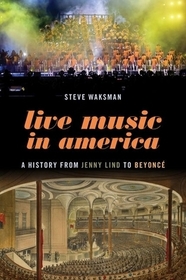
Live Music in America
A History from Jenny Lind to Beyoncé
- Publisher's listprice GBP 157.50
-
71 111 Ft (67 725 Ft + 5% VAT)
The price is estimated because at the time of ordering we do not know what conversion rates will apply to HUF / product currency when the book arrives. In case HUF is weaker, the price increases slightly, in case HUF is stronger, the price goes lower slightly.
- Discount 10% (cc. 7 111 Ft off)
- Discounted price 64 000 Ft (60 953 Ft + 5% VAT)
Subcribe now and take benefit of a favourable price.
Subscribe
71 111 Ft

Availability
printed on demand
Why don't you give exact delivery time?
Delivery time is estimated on our previous experiences. We give estimations only, because we order from outside Hungary, and the delivery time mainly depends on how quickly the publisher supplies the book. Faster or slower deliveries both happen, but we do our best to supply as quickly as possible.
Product details:
- Publisher OUP USA
- Date of Publication 14 November 2022
- ISBN 9780197570531
- Binding Hardback
- No. of pages692 pages
- Size 241x159x42 mm
- Weight 1089 g
- Language English
- Illustrations 54 halftones 237
Categories
Short description:
Live Music in America provides the first dedicated survey of music history in the United States as seen through the lens of live performance, offering readers a wide-ranging social and cultural history of American music that touches on race, class, gender, and debates over cultural value.
MoreLong description:
When the Swedish concert singer Jenny Lind toured the U.S. in 1850, she became the prototype for the modern pop star. Meanwhile, her manager, P.T. Barnum, became the prototype for another figure of enduring significance: the pop culture impresario. Starting with Lind's fabled U.S. tour and winding all the way into the twenty-first century, Live Music in America surveys the ongoing impact and changing conditions of live music performance in the U.S. It covers a range of historic performances, from the Fisk Jubilee Singers expanding the sphere of African American music in the 1870s, to Benny Goodman bringing swing to Carnegie Hall in 1938, to 1952's Moondog Coronation Ball in Cleveland - arguably the first rock and roll concert - to Beyoncé's boundary-shattering performance at the 2018 Coachella festival. More than that, the book details the roles played by performers, audiences, media commentators, and a variety of live music producers (promoters, agents, sound and stage technicians) in shaping what live music means and how it has evolved. Live Music in America connects what occurs behind the scenes to what takes place on stage to highlight the ways in which live music is very deliberately produced and does not just spontaneously materialize. Along the way, author Steve Waksman uses previously unstudied archival materials to shed new light on the origins of jazz, the emergence of rock 'n' roll, and the rise of the modern music festival.
Throughout, Waksman tilts the frame of music history and changes the image utterly. Open Live Music in America to any of its 692 pages and something will catch your interest. There are endless parallels with the music business of today, at every stage of the journey.
Table of Contents:
Preface and Acknowledgments
Introduction: Toward a History of Liveness
1. Selling the Nightingale: Jenny Lind, P.T. Barnum, and the Management of the American Crowd
2. Staging the Spiritual: The Fisk Jubilee Singers and the Postbellum Public Sphere
3. Economies of Performance: Tony Pastor, Ernest Hogan, and the Emergence of Vaudeville
4. Remaking Liveness: The Social Geography of Early Jazz
5. Culture High and Low: Reinventing Concert Music
6. The Perfect Package: Rock 'n' Roll Concerts in the 1950s
7. Crowds, Chaos, and Community: Music Festivals from Newport to New Orleans
8. The Politics of Scale: Arenas, Stadiums, and the Industrialization of Liveness
9. Staging Hip-Hop: Race, Rap, and the Remapping of Musical Performance
Conclusion: A Homecoming
Index

