

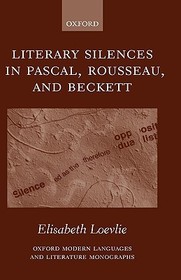
Literary Silences in Pascal, Rousseau, and Beckett
Series: Oxford Modern Language and Literature Monographs;
- Publisher's listprice GBP 167.50
-
75 626 Ft (72 025 Ft + 5% VAT)
The price is estimated because at the time of ordering we do not know what conversion rates will apply to HUF / product currency when the book arrives. In case HUF is weaker, the price increases slightly, in case HUF is stronger, the price goes lower slightly.
- Discount 10% (cc. 7 563 Ft off)
- Discounted price 68 064 Ft (64 823 Ft + 5% VAT)
Subcribe now and take benefit of a favourable price.
Subscribe
75 626 Ft

Availability
printed on demand
Why don't you give exact delivery time?
Delivery time is estimated on our previous experiences. We give estimations only, because we order from outside Hungary, and the delivery time mainly depends on how quickly the publisher supplies the book. Faster or slower deliveries both happen, but we do our best to supply as quickly as possible.
Product details:
- Publisher OUP Oxford
- Date of Publication 20 November 2003
- ISBN 9780199266364
- Binding Hardback
- No. of pages264 pages
- Size 220x144x20 mm
- Weight 447 g
- Language English 0
Categories
Short description:
To explore literary silence is to explore the relationships between literary texts and the silence of the ineffable. Philosophical and critical accounts tend to operate with a dualistic understanding of silence as the negative other of text. This study, however, seeks to place silence within the literary text. Central to this theoretical endeavour are thinkers like Blanchot, Derrida, Gadamer and Vattimo, and the result is a fundamental challenge to our ideas of silence and text. The study continues to draw on the ideas of Kierkegaard and Bataille to develop an effective methodology for reading such literary silences.
MoreLong description:
To explore literary silence is to explore the relationships between literary texts and the silence of the ineffable. It is to enquire what dynamics texts develop as they strive to 'say the unsayable', and it is to think literature as a silence that speaks itself. This study describes these literary and silent dynamics through readings of Pascal's Pensées, Rousseau's Rêveries, and Beckett's trilogy Molloy, Malone meurt, and L'Innommable. It contributes to our understanding of three major writers and challenges our idea of what silence is.
The subject of silence and of the ineffable has a long philosophical and critical tradition. A careful study of this tradition reveals the dominance of a limiting dualistic understanding of silence and its relationship to noise or language: silence becomes the negative other, the beyond, about which there remains nothing to say. The study of literary silence seeks rather to trace a language that becomes its own silence. It compromises the attempt to think a silence that moves within and through texts, that is inherent to the literary expression. Central to this theoretical endeavour are thinkers like Derrida, Deleuze, Gadamer, and Vattimo (among several others).
The theoretical understanding of silence permits an effective methodology for reading literary silence. Notions of repetition, the aporia and the implosion, which are developed in reference to Kierkegaard and Bataille, describe textual strategies of literary silence and structure the readings. Finally, the reading of literary silence has its point of reference in writers like Mallarmé, Blanchot, and Beckett. It is their texts that have taught us to become topological readers, to move in and out of texts' movements; they have shown us how the literary expression is irreducible to linear, meaning oriented language. As readers of such texts we have been prepared to read the dynamics of the unsayable, and finally to start discerning the silences of the literary.
rich in insight, and, for a study which espouses silence, seductively eloquent.
Table of Contents:
Introduction
Moving towards literary silence
Thinking literary silence - a theoretical exploration
The behaviour of literary silence: repetition, aporia, implosion
Literary silence in Pascal's Pensées
Literary silence in Rousseau's Rêveries
Interlude: From Rousseau to Beckett - the opening of the 'third mode' of language
Literary silence in Beckett's trilogy
Conclusion
Bibliography

