

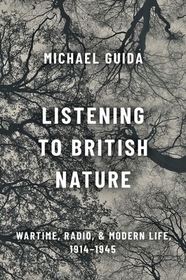
Listening to British Nature
Wartime, Radio, and Modern Life, 1914-1945
- Publisher's listprice GBP 78.00
-
35 217 Ft (33 540 Ft + 5% VAT)
The price is estimated because at the time of ordering we do not know what conversion rates will apply to HUF / product currency when the book arrives. In case HUF is weaker, the price increases slightly, in case HUF is stronger, the price goes lower slightly.
- Discount 10% (cc. 3 522 Ft off)
- Discounted price 31 695 Ft (30 186 Ft + 5% VAT)
Subcribe now and take benefit of a favourable price.
Subscribe
35 217 Ft

Availability
Estimated delivery time: In stock at the publisher, but not at Prospero's office. Delivery time approx. 3-5 weeks.
Not in stock at Prospero.
Why don't you give exact delivery time?
Delivery time is estimated on our previous experiences. We give estimations only, because we order from outside Hungary, and the delivery time mainly depends on how quickly the publisher supplies the book. Faster or slower deliveries both happen, but we do our best to supply as quickly as possible.
Product details:
- Publisher OUP USA
- Date of Publication 7 April 2022
- ISBN 9780190085537
- Binding Hardback
- No. of pages232 pages
- Size 164x235x20 mm
- Weight 472 g
- Language English 177
Categories
Short description:
Listening to British Nature: Wartime, Radio, and Modern Life, 1914-1945 arguesthat trench warfare created new practices of listening to nature in order to cultivate an intimate connection with its vibrations to understand danger and to imagine survival. In focusing on the sensing of sounds and rhythms, this study demonstrates how nature retained its emotional potency as the pace of life seemed to increase and new man-made sounds and sonic media appeared all around.
MoreLong description:
Listening to British Nature: Wartime, Radio, and Modern Life, 1914-1945 reveals for the first time how the sounds and rhythms of the natural world were listened to, interpreted and used amid the pressures of early twentieth century life. The book argues that despite and sometimes because of the chaos of wartime and the struggle to recover, nature's voices were drawn close to provide security and engender optimism. Nature's sonic presences were not obliterated by machine age noise, the advent of radio broadcasting or the rush of the urban everyday, rather they came to complement and provide alternatives to modern modes of living.
This book examines how trench warfare demanded the creation of new listening cultures to understand danger and to imagine survival. It tells of the therapeutic communities who made use of nature's quietude and the rhythms of rural work to restore shell-shocked soldiers, and of ramblers who sought to immerse themselves in the sensualities of the outdoors. It reveals how home-front listening during the Blitz was punctuated by birdsong, broadcast by the BBC. To listen to nature during this period was to cultivate an intimate connection with its energies and to sense an enduring order and beauty that could be taken into the future. Listening to nature was a way of being modern.
Of particular interest is Guida's account of Enham Village Centre (Hampshire), a model community established to help WW I veterans reintegrate into society through engagement in an idealized model of English life, where veterans lived and worked on crafts at a preindustrial pace. Alongside wartime nostalgia for a lost world of peaceful existence in nature, however, Guida recounts the emergence of the BBC's public service broadcasting, signifying "the beginning of a new kind of national listening" and modernity.
Table of Contents:
Introduction
1. Birdsong over the trenches: the sound of survival and escape
'The air is loud with death' - listening in fear for danger
Sonic relief amid the shelling
Regenerative rhythms
Resilience and 'carrying on' in birds and men
Skyward escape with the lark
Conclusion
2. Pastoral quietude for shell shock and national recovery
Quiet for the wounded?
Country house therapy
The 'beneficent alluring quietude' of the Village Centre utopia
Quiet for national recovery
Conclusion
3. Broadcasting nature
John Reith's public service nightingale
In touch with cosmic harmony
Normalising radio with nature
Conclusion
4. The rambler's search for the sensuous
Re-balancing the senses
Willis Marshall: into the moors
Nan Shepherd's merger with the mountain
A violent assertion of personality: hedonism in nature
Conclusion
5. Modern birdsong and civilisation at war
Recording and modernising birdsong
Home front listening tensions
'Consoling voices of the air': Ludwig Koch's broadcasts
Birdsong civilised and civilising
Conclusion
Afterword
Acknowledgements
Notes
Bibliography and sources
Index

