

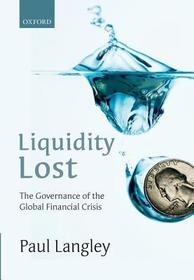
Liquidity Lost
The Governance of the Global Financial Crisis
- Publisher's listprice GBP 97.00
-
46 341 Ft (44 135 Ft + 5% VAT)
The price is estimated because at the time of ordering we do not know what conversion rates will apply to HUF / product currency when the book arrives. In case HUF is weaker, the price increases slightly, in case HUF is stronger, the price goes lower slightly.
- Discount 10% (cc. 4 634 Ft off)
- Discounted price 41 708 Ft (39 722 Ft + 5% VAT)
Subcribe now and take benefit of a favourable price.
Subscribe
46 341 Ft

Availability
printed on demand
Why don't you give exact delivery time?
Delivery time is estimated on our previous experiences. We give estimations only, because we order from outside Hungary, and the delivery time mainly depends on how quickly the publisher supplies the book. Faster or slower deliveries both happen, but we do our best to supply as quickly as possible.
Product details:
- Publisher OUP Oxford
- Date of Publication 11 December 2014
- ISBN 9780199683789
- Binding Hardback
- No. of pages236 pages
- Size 238x163x20 mm
- Weight 512 g
- Language English 0
Categories
Short description:
Contributing to interdisciplinary debates in cultural economy and the social studies of finance, and grounded in extensive empirical research, this book offers an innovative analysis of how the contemporary global financial crisis was governed. The focus is on the US and UK between 2007 and 2011
MoreLong description:
Contributing to interdisciplinary debates in cultural economy and the social studies of finance, and grounded in extensive empirical research, Liquidity Lost offers an innovative analysis of how the contemporary global financial crisis was governed. Through an exploration of the interventions made by central banks, treasuries, and regulatory authorities in the Anglo-American heartland of the crisis between 2007 and 2011, experimental and strategic apparatuses of crisis governance are shown to have emerged. These discrete apparatuses established six technical problems to be acted upon - liquidity, toxicity, solvency, risk, regulation, and debt - but also shared certain proclivities and preferences. Crisis governance assembled discourses and devices of economy in relation with sovereign monetary, fiscal, and regulatory techniques, and elicited an affective atmosphere of confidence. It also sought to secure the financialized way of life which turns on the opportunities ostensibly afforded by uncertain financial circulations, and gave rise to post-crisis technical fixes designed to advance the resilience of banking and the macro-prudential regulation of financial stability. Thus, the consensus that prevails across economics, political economy, and beyond - wherein sovereign state institutions are cast as coming to the rescue of the markets, banking, or neo-liberal capitalism - conceals a great deal more than it reveals about the governance of the global financial crisis.
This book by Langley ... offers an innovative analysis of how the global financial crisis of 2007 was governed ...Recommended
Table of Contents:
Introduction
Financial Crisis Governance
Liquidity
Toxicity
Solvency
Risk
Regulation
Debt
Conclusion

