

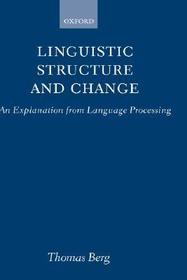
Linguistic Structure and Change
An Explanation from Language Processing
- Publisher's listprice GBP 180.00
-
85 995 Ft (81 900 Ft + 5% VAT)
The price is estimated because at the time of ordering we do not know what conversion rates will apply to HUF / product currency when the book arrives. In case HUF is weaker, the price increases slightly, in case HUF is stronger, the price goes lower slightly.
- Discount 10% (cc. 8 600 Ft off)
- Discounted price 77 396 Ft (73 710 Ft + 5% VAT)
Subcribe now and take benefit of a favourable price.
Subscribe
85 995 Ft

Availability
printed on demand
Why don't you give exact delivery time?
Delivery time is estimated on our previous experiences. We give estimations only, because we order from outside Hungary, and the delivery time mainly depends on how quickly the publisher supplies the book. Faster or slower deliveries both happen, but we do our best to supply as quickly as possible.
Product details:
- Publisher Clarendon Press
- Date of Publication 9 April 1998
- ISBN 9780198236726
- Binding Hardback
- No. of pages352 pages
- Size 242x163x24 mm
- Weight 674 g
- Language English
- Illustrations line figures, tables 0
Categories
Short description:
Thomas Berg analyses language as a psychological phenomenon in order to reach a clearer understanding of why the structure of language is the way it is and how it changes. He claims that real explanations of the structure of language can only emerge by establishing connections between language and its context. The explanatory power of one of these contexts, the psychological one, is examined in detail.
MoreLong description:
Thomas Berg challenges context-free theories of linguistics; he is concerned with the way the term 'explanation' is typically used in the discipline. He argues that real explanations cannot emerge from a view which asserts the autonomy of language, but only from an approach which seeks to establish a connection between language and the contexts in which it is embedded.
The author examines the psychological context in detail. He uses an interactiveactivation model of language processing to derive predictions about synchronic linguistic patterns, the course of linguistic change, and the structure of poetic rhymes. The majority of these predictions are borne out, leading the author to conclude that the structure of language is shaped by the properties of the mechanism which puts it to use, and that psycholinguistics thus qualifies as one likely approach from which to derive an explanation of linguistic structure.
Table of Contents:
On the 'art' of explanation
Explanation from a macrolinguistic perspective
Method
Language structure
Language change
Poetic language
Discussion
A psycholinguistic model of language structure and change
Implications for psycholinguistic theory
The overall perspective: reductionist or non-reductionist?
References
Index

