

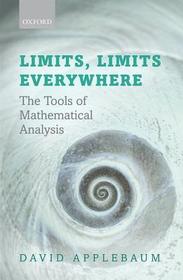
Limits, Limits Everywhere
The Tools of Mathematical Analysis
- Publisher's listprice GBP 36.99
-
16 700 Ft (15 905 Ft + 5% VAT)
The price is estimated because at the time of ordering we do not know what conversion rates will apply to HUF / product currency when the book arrives. In case HUF is weaker, the price increases slightly, in case HUF is stronger, the price goes lower slightly.
- Discount 10% (cc. 1 670 Ft off)
- Discounted price 15 030 Ft (14 315 Ft + 5% VAT)
Subcribe now and take benefit of a favourable price.
Subscribe
16 700 Ft

Availability
printed on demand
Why don't you give exact delivery time?
Delivery time is estimated on our previous experiences. We give estimations only, because we order from outside Hungary, and the delivery time mainly depends on how quickly the publisher supplies the book. Faster or slower deliveries both happen, but we do our best to supply as quickly as possible.
Product details:
- Publisher OUP Oxford
- Date of Publication 1 March 2012
- ISBN 9780199640089
- Binding Paperback
- No. of pages218 pages
- Size 234x153x12 mm
- Weight 347 g
- Language English
- Illustrations 33 black and white line drawings 0
Categories
Short description:
An account of elementary real analysis positioned between a popular mathematics book and a first year college or university text. This book doesn't assume knowledge of calculus and, instead, the emphasis is on the application of analysis to number theory.
MoreLong description:
A quantity can be made smaller and smaller without it ever vanishing. This fact has profound consequences for science, technology, and even the way we think about numbers. In this book, we will explore this idea by moving at an easy pace through an account of elementary real analysis and, in particular, will focus on numbers, sequences, and series.
Almost all textbooks on introductory analysis assume some background in calculus. This book doesn't and, instead, the emphasis is on the application of analysis to number theory. The book is split into two parts. Part 1 follows a standard university course on analysis and each chapter closes with a set of exercises. Here, numbers, inequalities, convergence of sequences, and infinite series are all covered. Part 2 contains a selection of more unusual topics that aren't usually found in books of this type. It includes proofs of the irrationality of e and π, continued fractions, an introduction to the Riemann zeta function, Cantor's theory of the infinite, and Dedekind cuts. There is also a survey of what analysis can do for the calculus and a brief history of the subject.
A lot of material found in a standard university course on "real analysis" is covered and most of the mathematics is written in standard theorem-proof style. However, more details are given than is usually the case to help readers who find this style daunting. Both set theory and proof by induction are avoided in the interests of making the book accessible to a wider readership, but both of these topics are the subjects of appendices for those who are interested in them. And unlike most university texts at this level, topics that have featured in popular science books, such as the Riemann hypothesis, are introduced here. As a result, this book occupies a unique position between a popular mathematics book and a first year college or university text, and offers a relaxed introduction to a fascinating and important branch of mathematics.
This book does not offer an easy ride but its informal and enthusiastic literary style hold ones attention. Perhaps mindful of the content of much current popular mathematical exposition, the author draws many illustrations from number theory.
Table of Contents:
Introduction
I Approaching Limits
A Whole Lot of Numbers
Let's Get Real
The Joy of Inequality
Where Do You Go To, My Lovely
Bounds for Glory
You Cannot be Series
II Exploring Limits
Wonderful Numbers
Infinite Products
Continued Fractions
How Infinite Can You Get?
Constructing the Real Numbers
Where to Next in Analysis? The Calculus
Some Brief Remarks About the History of Analysis
Further Reading
Apendices
The Binomial Theorem
The Language of Set Theory
Proof by Mathematical Induction
The Algebra of Numbers
Hints and Selected Solutions

