

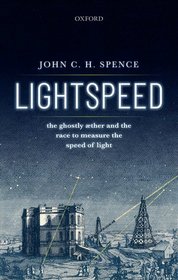
Lightspeed
The Ghostly Aether and the Race to Measure the Speed of Light
- Publisher's listprice GBP 35.99
-
16 249 Ft (15 475 Ft + 5% VAT)
The price is estimated because at the time of ordering we do not know what conversion rates will apply to HUF / product currency when the book arrives. In case HUF is weaker, the price increases slightly, in case HUF is stronger, the price goes lower slightly.
- Discount 20% (cc. 3 250 Ft off)
- Discounted price 12 999 Ft (12 380 Ft + 5% VAT)
- Discount is valid until: 30 June 2026
Subcribe now and take benefit of a favourable price.
Subscribe
16 249 Ft

Availability
Estimated delivery time: In stock at the publisher, but not at Prospero's office. Delivery time approx. 3-5 weeks.
Not in stock at Prospero.
Why don't you give exact delivery time?
Delivery time is estimated on our previous experiences. We give estimations only, because we order from outside Hungary, and the delivery time mainly depends on how quickly the publisher supplies the book. Faster or slower deliveries both happen, but we do our best to supply as quickly as possible.
Product details:
- Publisher OUP Oxford
- Date of Publication 14 October 2019
- ISBN 9780198841968
- Binding Hardback
- No. of pages256 pages
- Size 224x145x20 mm
- Weight 466 g
- Language English
- Illustrations 19 grayscale and 11 color line figures; 13 grayscale and 5 color halftone figures 0
Categories
Short description:
This book tells the story of one of man's greatest intellectual adventures - how it came to be understood that light travels at a finite speed, so that when we look up at the stars we are looking back in time. From the ancient Greeks measuring the distance to the sun, to today's satellite navigation, the book offers a gripping historical journey.
MoreLong description:
This book tells the human story of one of man's greatest intellectual adventures - how it came to be understood that light travels at a finite speed, so that when we look up at the stars, we are looking back in time. And how the search for a God-given absolute frame of reference in the universe led most improbably to Einstein's most famous equation E=mc2, which represents the energy that powers the stars and nuclear weapons. From the ancient Greeks measuring the solar system, to the theory of relativity and satellite navigation, the book takes the reader on a gripping historical journey. We learn how Galileo discovered the moons of Jupiter and used their eclipses as a global clock, allowing travellers to find their Longitude. And how Ole Roemer, noticing that the eclipses were a little late, used this to obtain the first measurement of the speed of light, which takes eight minutes to get to us from the sun. We move from the international collaborations to observe the Transits of Venus, including Cook's voyage to Australia, to the achievements of Young and Fresnel, whose discoveries eventually taught us that light travels as a wave but arrives as a particle, and all the quantum weirdness which follows. In the nineteenth century, we find Faraday and Maxwell, struggling to understand how light can propagate through the vacuum of space unless it is filled with a ghostly vortex Aether foam. We follow the brilliantly gifted experimentalists Hertz, discoverer of radio, Michelson with his search for the Aether wind, and Foucault and Fizeau with their spinning mirrors and lightbeams across the rooftops of Paris. Messaging faster than light using quantum entanglement, and the reality of the quantum world, conclude this saga.
The richly illustrated study and reference book Lightspeed tells in a pleasant and fascinating way the course of history in the search for the natural presence of light and its physical properties.
Table of Contents:
Early Ideas
Ole Roemer, Who Started It All
Measuring the Cosmos. Parallax and the Transit of Venus
James Bradley, Sailing On the Thames. The Best Experiment
The 19th Century. Light Beams Across the Rooftops of Paris
Faraday and Maxwell - The Grand Synthesis
Albert Michelson and the Aether Wind
Einstein: The Great Clarification
Radio and Telecommunications. Spacecraft
Faster-Than Light Schemes. Quantum Reality

