

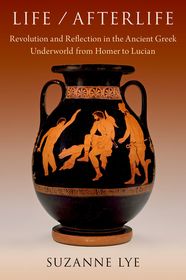
Life / Afterlife
Revolution and Reflection in the Ancient Greek Underworld from Homer to Lucian
- Publisher's listprice GBP 59.00
-
26 638 Ft (25 370 Ft + 5% VAT)
The price is estimated because at the time of ordering we do not know what conversion rates will apply to HUF / product currency when the book arrives. In case HUF is weaker, the price increases slightly, in case HUF is stronger, the price goes lower slightly.
- Discount 10% (cc. 2 664 Ft off)
- Discounted price 23 975 Ft (22 833 Ft + 5% VAT)
Subcribe now and take benefit of a favourable price.
Subscribe
26 638 Ft

Availability
printed on demand
Why don't you give exact delivery time?
Delivery time is estimated on our previous experiences. We give estimations only, because we order from outside Hungary, and the delivery time mainly depends on how quickly the publisher supplies the book. Faster or slower deliveries both happen, but we do our best to supply as quickly as possible.
Product details:
- Publisher OUP USA
- Date of Publication 20 December 2024
- ISBN 9780197690208
- Binding Hardback
- No. of pages336 pages
- Size 249x165x30 mm
- Weight 635 g
- Language English 564
Categories
Short description:
Life / Afterlife traces the development, evolution, and uses of underworld scenes in ancient Greek literature and society. Underworld scenes are a unique form of embedded storytelling, appearing across time and genres. These scenes employ a special register of language that acts as a narrative space outside of chronological time and everyday reality. Suzanne Lye shows how writers such as Homer, Hesiod, Aristophanes, Plato, and Lucian, among others, used afterlife depictions as commentaries to communicate a call to action for their audiences in response to cultural, religious, and political changes to their worlds.
MoreLong description:
Life / Afterlife traces the development, evolution, and uses of underworld scenes in ancient Greek literature and society. Underworld scenes are a unique form of embedded storytelling, appearing across time and genres. These scenes employ a special register of language that acts as a narrative space outside of chronological time and everyday reality. Suzanne Lye shows how writers such as Homer, Hesiod, Aristophanes, Plato, and Lucian, among others, used afterlife depictions as commentaries to communicate a call to action for their audiences in response to cultural, religious, and political changes to their worlds. Using networks of underworld scenes which often featured mythic and historical figures, authors could reinforce or challenge traditional religious and cultural beliefs and practices by presenting the long-term, cosmic effects of actions in life on an individual's post-death experience.
From ancient to modern times, underworld scenes have helped authors and audiences define the essential qualities of a "good life" for different social, political, and religious groups and their societies. This book offers an approach to reading underworld scenes that explains how they function and why they have persisted in various forms, both literary and artistic, from the eighth-century B.C.E. to the present day.
Lye's hypertextual approach provides rich insights into Underworld scenes in Greek literature, deftly combining innovative theoretical methodology with careful close readings of particular scenes. She shows how authors create meaning in conjunction with their readers by crafting their accounts to enable links with the traditional elements of Underworld scenes, making a nexus with other tellings familiar to their audiences. Specialists and students alike will benefit from this excellent study.
Table of Contents:
Introduction
The Synoptic Underworld: Overview of a Narrative Construct
Afterlife Poetics and Homer's Heroic Underworlds
Becoming Blessed and Underworlds of Judgment
Crafting Heroic Blessedness through Underworld Scenes
World and Underworld: Democratizing the Afterlife through Underworld Scenes
Plato's Underworlds: Revising the Afterlife
Epilogue: The Afterlife of the Afterlife

