

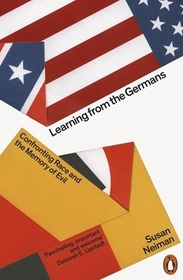
Learning from the Germans
Confronting Race and the Memory of Evil
-
GET 20% OFF
- Publisher's listprice GBP 10.99
-
4 961 Ft (4 725 Ft + 5% VAT)
The price is estimated because at the time of ordering we do not know what conversion rates will apply to HUF / product currency when the book arrives. In case HUF is weaker, the price increases slightly, in case HUF is stronger, the price goes lower slightly.
- Discount 20% (cc. 992 Ft off)
- Discounted price 3 969 Ft (3 780 Ft + 5% VAT)
- Discount is valid until: 31 August 2026
3 969 Ft

Availability
Uncertain availability. Please turn to our customer service.
Why don't you give exact delivery time?
Delivery time is estimated on our previous experiences. We give estimations only, because we order from outside Hungary, and the delivery time mainly depends on how quickly the publisher supplies the book. Faster or slower deliveries both happen, but we do our best to supply as quickly as possible.
Product details:
- Publisher Penguin Books Ltd
- Date of Publication 27 August 2020
- Number of Volumes B-format paperback
- ISBN 9780141983424
- Binding Paperback
- No. of pages432 pages
- Size 197x128x23 mm
- Weight 318 g
- Language English 0
Categories
Long description:
'An ambitious and engrossing investigation of the moral legacies which stubbornly refuse to pass' Brendan Simms
As the western world struggles with its legacies of racism and colonialism, what can we learn from the past in order to move forward?
Susan Neiman's Learning from the Germans delivers an urgently needed perspective on how a country can come to terms with its historical wrongdoings. Neiman, who grew up as a white girl in the American South during the civil rights movement, is a Jewish woman who has spent much of her adult life in Berlin. In clear and gripping prose, she uses this unique perspective to combine philosophical reflection, personal history and conversations with both Americans and Germans who are grappling with the evils of their own national histories.
Through focusing on the particularities of those histories, she provides examples for other nations, whether they are facing resurgent nationalism, ongoing debates over reparations or controversies surrounding historical monuments and the contested memories they evoke. It is necessary reading for all those confronting their own troubled pasts.

