

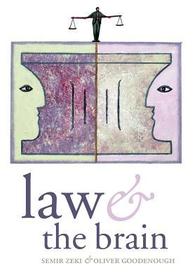
Law and the Brain
- Publisher's listprice GBP 69.00
-
31 153 Ft (29 670 Ft + 5% VAT)
The price is estimated because at the time of ordering we do not know what conversion rates will apply to HUF / product currency when the book arrives. In case HUF is weaker, the price increases slightly, in case HUF is stronger, the price goes lower slightly.
- Discount 10% (cc. 3 115 Ft off)
- Discounted price 28 038 Ft (26 703 Ft + 5% VAT)
Subcribe now and take benefit of a favourable price.
Subscribe
31 153 Ft

Availability
printed on demand
Why don't you give exact delivery time?
Delivery time is estimated on our previous experiences. We give estimations only, because we order from outside Hungary, and the delivery time mainly depends on how quickly the publisher supplies the book. Faster or slower deliveries both happen, but we do our best to supply as quickly as possible.
Product details:
- Publisher OUP Oxford
- Date of Publication 23 February 2006
- ISBN 9780198570110
- Binding Paperback
- No. of pages290 pages
- Size 239x167x17 mm
- Weight 499 g
- Language English
- Illustrations Halftones and line drawings 0
Categories
Short description:
Applying our new found knowledge from neuroscience to the discipline of law seems a natural development - the making, considering, and enforcing of law of course rests on mental processes. However, there are real issues that the legal system will face as neurobiological studies continue to relentlessly probe the human mind. This volume represents the first serious attempt to address questions of law as reflecting brain activity, emphasizing that it is the organization and functioning of the brain that determines how we enact and obey laws.
MoreLong description:
The past 20 years have seen unparalleled advances in neurobiology, with findings from neuroscience being used to shed light on a range of human activities - many historically the province of those in the humanities and social sciences - aesthetics, emotion, consciousness, music. Applying this new knowledge to law seems a natural development - the making, considering, and enforcing of law of course rests on mental processes. However, where some of those activities can be studied with a certain amount of academic detachment, what we discover about the brain has considerable implications for how we consider and judge those who follow or indeed flout the law - with inevitable social and political consequences. There are real issues that the legal system will face as neurobiological studies continue to relentlessly probe the human mind - the motives for our actions, our decision making processes, and such issues as free will and responsibility.
This volume represents a first serious attempt to address questions of law as reflecting brain activity, emphasizing that it is the organization and functioning of the brain that determines how we enact and obey laws. It applies the most recent developments in brain science to debates over criminal responsibility, cooperation and punishment, deception, moral and legal judgment, property, evolutionary psychology, law and economics, and decision-making by judges and juries. Written and edited by leading specialists from a range of disciplines, the book presents a groundbreaking and challenging new look at human behaviour.
This collection of fourteen fascinating and beautifully written essays is the first emphatic assertion that the law needs neuroscience if it is not to be a hopeless intellectual ostrich, and the first attempt to write a tentative agenda for the debate that has to happen. Few subjects matter more. Anyone who wants to learn the vocabulary of the subject needs this book.
Table of Contents:
Introduction
Law and the Brain - an introduction
Introductory Essays
The neuroeconomic path of the law
How neuroscience might advance the law
Law, Biology and the Brain
Law and the sources of morality
Law, evolution and the brain: applications and open questions
A neuroscientific approach to normative judgment in law and justice
Neuroeconomics and Law
The brain and the law
Neuroeconomics
Decision Making and Evidence
A cognitive neuroscience framework for understanding causal reasoning and the law
Truthfulness
A cognitive neurobiological account of deception: evidence from functional neuroimaging
Property in Biology and the Brain
The property 'instinct'
Criminal Responsibility and Punishment
For the law, neuroscience changes nothing and everything
The frontal cortex and the criminal justice system
The emergence of consequential thought: evidence from neuroscience
Responsibility and punishment: whose mind? A response

