

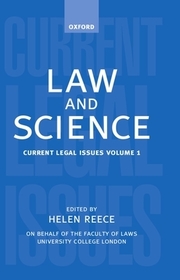
- Publisher's listprice GBP 90.00
-
42 997 Ft (40 950 Ft + 5% VAT)
The price is estimated because at the time of ordering we do not know what conversion rates will apply to HUF / product currency when the book arrives. In case HUF is weaker, the price increases slightly, in case HUF is stronger, the price goes lower slightly.
- Discount 10% (cc. 4 300 Ft off)
- Discounted price 38 698 Ft (36 855 Ft + 5% VAT)
Subcribe now and take benefit of a favourable price.
Subscribe
42 997 Ft

Availability
printed on demand
Why don't you give exact delivery time?
Delivery time is estimated on our previous experiences. We give estimations only, because we order from outside Hungary, and the delivery time mainly depends on how quickly the publisher supplies the book. Faster or slower deliveries both happen, but we do our best to supply as quickly as possible.
Product details:
- Edition number and title Law and Science v.1
- Publisher OUP Oxford
- Date of Publication 30 July 1998
- ISBN 9780198267942
- Binding Hardback
- No. of pages332 pages
- Size 224x143x20 mm
- Weight 478 g
- Language English 0
Categories
Short description:
This is the first volume of an exciting new series, Current Legal Issues, which will be published each spring as a sister volume to Current Legal Problems. This book is the first volume in the series and explores the relationship of law and science, with a particular focus on the role of science as evidence. Scientific evidence impinges on a wide range of legal issues, including, for example, risk assessment in mental health and child abuse, criminal investigations, chemical and medical products, mass tort cases and the attribution of paternity. Science promises to reduce (or even eliminate) uncertainty; how should lawyers respond to such ambitious claims? As the civil justice process undergoes a major overhaul, this diverse and stimulating collection of essays provides a timely and thought-provoking reassessment of the relationship between law and science in general and the uses and value of scientific evidence in particular.
MoreLong description:
This is the first volume of an exciting new series, Current Legal Issues, which will be published each spring as a sister volume to Current Legal Problems. The basis for each interdisciplinary volume will be a two-day colloquium held each year by the Faculty of Laws at University College London. This first volume explores the interrelationship of law and science. Future volumes will examine themes such as law and literature, law and medicine, law and religion, etc.
This book, the first volume of Current Legal Issues, explores the relationship of law and science, with a particular focus on the role of science as evidence. Scientific evidence impinges on a wide range of legal issues, including, for example, risk assessment in mental health and child abuse, criminal investigations, chemical and medical products, mass tort cases and the attribution of paternity. Science promises to reduce (or even eliminate) uncertainty; how should lawyers respond to such ambitious claims? As the civil justice process undergoes a major overhaul, this diverse and stimulating collection of essays provides a timely and thought-provoking reassessment of the relationship between law and science in general and the uses and value of scientific evidence in particular.
From the Editors' Introduction
This volume addresses the intersection between law and science, two monolithic institutions which generally compete for, but sometimes coincide in presenting, an authoritative analysis of the world. The contributors to this volume take different views as to who is the victor in this contest Science deals in objective reality; therefore it is for scientists to reveal as much as they can about reality, and for the law to determine what should be made of the discoveries. Perhaps this division of labour is too simplistic, but if it is taken as a model, it is apparent that law and science are bound together and that mutual understanding is essential. If this volume contributes to that understanding then it will have performed an invaluable service.
Table of Contents:
Cognitive science, legal theory and the possibility of an observation/theory distinction in morality and law
Science, reason, and tort law: looking for the reasonable person
The role of scientific evidence in the assessment of causation in medicinal product liability litigation: a probabilistic and economic analysis
Pedro Juan Cubillo v Commonwealth of Australia (1995): right result, wrong method
The BSE crisis: a study of the precautionary principle and the politics of science in law
A new criterion for the admissibility of scientific evidence? The metamorphosis of helpfulness
Reflections on expert evidence in Canadian criminal proceedings: more lessons from North America
The risks and dangers of experts in court
Laws truth, lay truth and medical science: three case studies
Brainwashing evidence in the light of Daubert: science and unpopular religions
What lawyers need to know about science

