

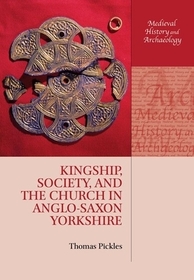
Kingship, Society, and the Church in Anglo-Saxon Yorkshire
Series: Medieval History and Archaeology;
- Publisher's listprice GBP 132.50
-
59 823 Ft (56 975 Ft + 5% VAT)
The price is estimated because at the time of ordering we do not know what conversion rates will apply to HUF / product currency when the book arrives. In case HUF is weaker, the price increases slightly, in case HUF is stronger, the price goes lower slightly.
- Discount 10% (cc. 5 982 Ft off)
- Discounted price 53 841 Ft (51 278 Ft + 5% VAT)
Subcribe now and take benefit of a favourable price.
Subscribe
59 823 Ft

Availability
printed on demand
Why don't you give exact delivery time?
Delivery time is estimated on our previous experiences. We give estimations only, because we order from outside Hungary, and the delivery time mainly depends on how quickly the publisher supplies the book. Faster or slower deliveries both happen, but we do our best to supply as quickly as possible.
Product details:
- Publisher OUP Oxford
- Date of Publication 29 November 2018
- ISBN 9780198818779
- Binding Hardback
- No. of pages414 pages
- Size 249x179x27 mm
- Weight 1008 g
- Language English
- Illustrations black and white figures/illustrations 0
Categories
Short description:
A study of social organization, political power, conversion to Christianity, and church building in Anglo-Saxon Yorkshire in 400-1066 AD, Kingship, Society, and the Church in Anglo-Saxon Yorkshire argues that the decision of local kin-groups to convert to Christianity transformed kingship, society, and even the physical landscape.
MoreLong description:
Inspired by studies of Carolingian Europe, Kingship, Society and the Church in Anglo-Saxon Yorkshire argues that the social strategies of local kin-groups drove conversion to Christianity and church building in Yorkshire from 400-1066 AD. It challenges the emphasis that has been placed on the role and agency of Anglo-Saxon kings in conversion and church building, and moves forward the debate surrounding the 'minster hypothesis' through an inter-disciplinary case study.
Members of Deiran kin-groups faced uncertainties that predisposed them to consider conversion as a social strategy, in their rule between 600 and 867. Their decision to convert produced a new social fraction - the 'ecclesiastical aristocracy' - with a distinctive but fragile identity. The 'ecclesiastical aristocracy' transformed kingship, established a network of religious communities, and engaged in the conversion of the laity. The social and political instabilities produced by conversion along with the fragility of ecclesiastical identity resulted in the expropriation and re-organization of many religious communities. Nevertheless, the Scandinavian and West Saxon kings and their nobles allied with wealthy and influential archbishops of York, and there is evidence for the survival, revival, or foundation of religious communities as well as the establishment of local churches.
A hugely impressive volume that deserves to generate more detailed studies in Yorkshire, and comparable explotations of other parts of Danelaw.
Table of Contents:
Introduction
The Kingdom of the Deirans, 450-c. 650
The 'Ecclesiastical Aristocracy', 600- c. 730
Politics, Conversionm and Christianization 616-c. 867
The 'Ecclesiastical Aristocracy' and the Laity, 600-c. 867
Kingship, Social Change, and the Church, 867-c. 1066
Religious Communities, Local Churches, and the Laity, 867-c. 1066
Conclusion
Bibliography

