

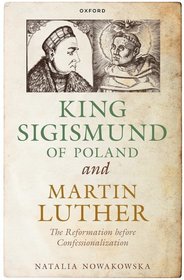
King Sigismund of Poland and Martin Luther
The Reformation before Confessionalization
- Publisher's listprice GBP 24.99
-
11 282 Ft (10 745 Ft + 5% VAT)
The price is estimated because at the time of ordering we do not know what conversion rates will apply to HUF / product currency when the book arrives. In case HUF is weaker, the price increases slightly, in case HUF is stronger, the price goes lower slightly.
- Discount 20% (cc. 2 256 Ft off)
- Discounted price 9 026 Ft (8 596 Ft + 5% VAT)
- Discount is valid until: 30 June 2026
Subcribe now and take benefit of a favourable price.
Subscribe
11 282 Ft

Availability
Estimated delivery time: In stock at the publisher, but not at Prospero's office. Delivery time approx. 3-5 weeks.
Not in stock at Prospero.
Why don't you give exact delivery time?
Delivery time is estimated on our previous experiences. We give estimations only, because we order from outside Hungary, and the delivery time mainly depends on how quickly the publisher supplies the book. Faster or slower deliveries both happen, but we do our best to supply as quickly as possible.
Product details:
- Publisher OUP Oxford
- Date of Publication 15 June 2023
- ISBN 9780198889434
- Binding Paperback
- No. of pages304 pages
- Size 234x157x17 mm
- Weight 450 g
- Language English
- Illustrations 6 black and white figures/illustrations 412
Categories
Short description:
The Polish monarchy had a great impact on the rise of Lutheranism. King Sigismund (1506-1548) turned a blind eye to many Lutheran activities, and this study sees his tacit acceptance as an argument for the notion that he didn't see Lutheranism as a threat to the existing catholic Christianity, but as a variant form of the same faith.
MoreLong description:
The first major study of the early Reformation and the Polish monarchy for over a century, this volume asks why Crown and church in the reign of King Sigismund I (1506-1548) did not persecute Lutherans. It offers a new narrative of Luther's dramatic impact on this monarchy --- which saw violent urban Reformations and the creation of Christendom's first Lutheran principality by 1525 --- placing these events in their comparative European context. King Sigismund's realm appears to offer a major example of sixteenth-century religious toleration: the king tacitly allowed his Hanseatic ports to enact local Reformations, enjoyed excellent relations with his Lutheran vassal duke in Prussia, allied with pro-Luther princes across Europe, and declined to enforce his own heresy edicts. Polish church courts allowed dozens of suspected Lutherans to walk free.
Examining these episodes in turn, this study does not treat toleration purely as the product of political calculation or pragmatism. Instead, through close analysis of language, it reconstructs the underlying cultural beliefs about religion and church (ecclesiology) held by the king, bishops, courtiers, literati, and clergy --- asking what, at heart, did these elites understood 'Lutheranism' and 'catholicism' to be? It argues that the ruling elites of the Polish monarchy did not persecute Lutheranism because they did not perceive it as a dangerous Other --- but as a variant form of catholic Christianity within an already variegated late medieval church, where social unity was much more important than doctrinal differences between Christians. Building on John Bossy and borrowing from J.G.A. Pocock, it proposes a broader hypothesis on the Reformation as a shift in the languages and concept of orthodoxy.
a truly path-breaking work. It is based on a command of a large primary and secondary printed and manuscript literature. It will be a must read for specialists in the history of the early modern Commonwealth, and, most welcome --- I can't stress this enough --- for important, serious scholars of the Reformation and the Counter-Reformation
Table of Contents:
PART 1: HYPOTHESIS
Introduction: Beyond Toleration - the Reformation before Confessionalisation
PART 2. CONTEXTS
People, Places, Texts
A New Narrative? The Polish Monarchy & the Early Reformation (1518-c.1540)
PART 3. EPISODES
Drama in Danzig: The Crown & Reformation in Royal Prussia.
A Naughty Nephew: The Polish Crown & Lutheran Ducal Prussia
Hollow Law? Royal Edicts Against Lutheranism
'A Most Pious Prince': The Reformation Diplomacy of Sigismund I
A Smoked Pig, Monsters & Sheep: The Polish Church and Lutheranism
PART 4. LANGUAGE ANALYSIS
Defining Lutheranism
Defining Catholicism
Conclusions

