

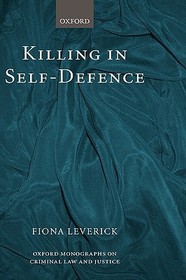
Killing in Self-Defence
Series: Oxford Monographs on Criminal Law and Justice;
- Publisher's listprice GBP 115.00
-
51 922 Ft (49 450 Ft + 5% VAT)
The price is estimated because at the time of ordering we do not know what conversion rates will apply to HUF / product currency when the book arrives. In case HUF is weaker, the price increases slightly, in case HUF is stronger, the price goes lower slightly.
- Discount 10% (cc. 5 192 Ft off)
- Discounted price 46 730 Ft (44 505 Ft + 5% VAT)
Subcribe now and take benefit of a favourable price.
Subscribe
51 922 Ft

Availability
printed on demand
Why don't you give exact delivery time?
Delivery time is estimated on our previous experiences. We give estimations only, because we order from outside Hungary, and the delivery time mainly depends on how quickly the publisher supplies the book. Faster or slower deliveries both happen, but we do our best to supply as quickly as possible.
Product details:
- Publisher OUP Oxford
- Date of Publication 7 December 2006
- ISBN 9780199283460
- Binding Hardback
- No. of pages240 pages
- Size 240x160x20 mm
- Weight 516 g
- Language English 0
Categories
Short description:
In what circumstances should we be allowed to kill an intruder who breaks into our home? Should battered women be forgiven for killing their husbands? This book analyses the questions raised by the argument of self-defence, and offers a unique theoretical framework for understanding the defence in the context of human rights norms.
MoreLong description:
This book is a comprehensive analysis of the criminal defence of self-defence from a philosophical, legal and human rights perspective. The primary focus is on self-defence as a defence to homicide, as this is the most difficult type of self-defensive force to justify. Although not always recognised as such, self-defence is a contentious defence, permitting as it does the victim of an attack to preserve her life at the expense of another. If one holds that all human life is of equal value, explaining why this is permissible poses something of a challenge. It is particularly difficult to explain where the aggressor is, for reasons of non-age or insanity for example, not responsible for her actions.
The first part of the book is devoted to identifying the proper theoretical basis of a claim of self-defence. It examines the classification of defences, and the concepts of justification and excuse in particular, and locates self-defence within this classification. It considers the relationship between self-defence and the closely related defences of duress and necessity. It then proceeds critically to analyse various philosophical explanations of why self-defensive killing is justified, before concluding that the most convincing account is one that draws on the right to life with an accompanying theory of forfeiture.
The book then proceeds to draw upon this analysis to examine various aspects of the law of self-defence. There is detailed analysis of the way in which, on a human rights approach, it is appropriate to treat the issues of retreat, imminence of harm, self-generated self-defence, mistake and proportionality, with a particular focus on whether lethal force is ever permissible in protecting property or in preventing rape. The analysis draws on material from all of the major common law jurisdictions.
The book concludes with an examination of the implications that the European Convention on Human Rights might have for the law of self-defence, especially in the areas of mistaken belief and the degree of force permissible to protect property.
One of the strengths of Fiona Leverick's book on killing and self-defense is that it is a broad, comparative analysis of the law across a variety of jurisdictions, which sheds light on specific problems in particular legal systems. A second strength is that it recognizes the need for a general theory of self-defense based on the first principles, and that this needs to be located in an understanding of the law's structure.
Table of Contents:
Introduction
The Classification of Defences
The Justification of Self-Defence
Retreat
Imminence of Harm
Self-Generated Self-Defence
Killing to Protect Property
Killing to Prevent Rape
Mistake
The Impact of the European Convention on Human Rights

