

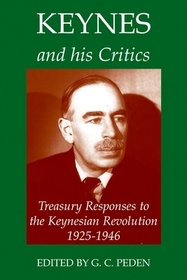
Keynes and his Critics
Treasury Responses to the Keynesian Revolution, 1925-1946
Series: Records of Social and Economic History; 36;
- Publisher's listprice GBP 80.00
-
36 120 Ft (34 400 Ft + 5% VAT)
The price is estimated because at the time of ordering we do not know what conversion rates will apply to HUF / product currency when the book arrives. In case HUF is weaker, the price increases slightly, in case HUF is stronger, the price goes lower slightly.
36 120 Ft

Availability
Estimated delivery time: In stock at the publisher, but not at Prospero's office. Delivery time approx. 3-5 weeks.
Not in stock at Prospero.
Why don't you give exact delivery time?
Delivery time is estimated on our previous experiences. We give estimations only, because we order from outside Hungary, and the delivery time mainly depends on how quickly the publisher supplies the book. Faster or slower deliveries both happen, but we do our best to supply as quickly as possible.
Product details:
- Publisher The British Academy
- Date of Publication 16 December 2004
- ISBN 9780197263228
- Binding Hardback
- No. of pages390 pages
- Size 243x163x10 mm
- Weight 783 g
- Language English
- Illustrations 9 halftones 0
Categories
Short description:
These documents, published here for the first time, present the Treasury's counter-arguments during the period when Keynes was developing the ideas that led to the Keynesian revolution in economic policy. Economists and historians have tended to assume that Keynes was right and the Treasury was wrong; this volume shows that the Treasury anticipated the political problems that would be encountered in putting Keynes's ideas into practice. The topics covered include the return to the gold standard, unemployment, inflation and the international economy. This edition complements the Royal Economic Society's Collected Writings of John Maynard Keynes, and sheds new light on a formative period in British history.
MoreLong description:
These documents, published here for the first time, present the Treasury's counter-arguments during the period when Keynes was developing the ideas that led to the Keynesian revolution in economic policy.
Keynes spent much effort trying to persuade the Treasury to adopt policies designed to raise employment and stabilise prices, and to create an international monetary system that would favour these objectives. His arguments are set out fully in the Royal Economic Society's 30-volume set of The Collected Writings of John Maynard Keynes. In contrast, the views of his Treasury critics have hitherto been much less accessible.
Economists and historians have tended to assume that Keynes was right and the Treasury was wrong; this volume shows that the Treasury anticipated the political problems that would be encountered in putting Keynes's ideas into practice. Much of what Keynes published was deliberately polemical: he believed that words should be 'a little wild', for they were 'the assault of thought on the unthinking'. Treasury officials were by no means as unthinking as Keynes tended to portray them, and they had a coherent and intellectually respectable understanding of public finance. Ministers in the inter-war period and early in the Second World War were sensitive to the use that political opponents might make of Keynes's arguments; officials had to provide counter-arguments, and in doing so they revealed much about their views on economics and public finance. Once Keynes became an adviser to the Chancellor of the Exchequer in 1940, the debate became internal to the Treasury, but officials continued to subject Keynes's ideas to critical analysis.
The documents in this volume show Treasury responses to Keynes on a range of issues crucial to understanding the period and the context of the Keynesian revolution in public policy. The topics covered include: the return to the gold standard; the use of public expenditure to cure unemployment in the inter-war period; how to avoid inflation in the war; planning for the post-war international economy; and the 1944 white paper on employment policy.
This edition is an essential tool for the study of a formative period of British history and a great intellectual debate.
Keynes remains a commanding figure both in the history of economic theory and in the history of economic policy, especially that pursued by the British Treasury . . . Nobody has documented the activities of the 20th-century Treasury more authoritatively than Peden, or more convincingly entered into the mentality of the Treasury knights, who arguments for resisting Keynes used to be caricatured by second-generation Keynesians as simply laughable.Keynes and His Critics, by printing their internal memoranda and minutes, allows them to speak for themselves More

