

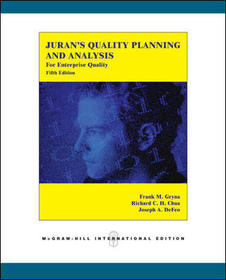
Juran's Quality Planning and Analysis for Enterprise Quality
- Publisher's listprice GBP 52.99
-
23 924 Ft (22 785 Ft + 5% VAT)
The price is estimated because at the time of ordering we do not know what conversion rates will apply to HUF / product currency when the book arrives. In case HUF is weaker, the price increases slightly, in case HUF is stronger, the price goes lower slightly.
- Discount 10% (cc. 2 392 Ft off)
- Discounted price 21 532 Ft (20 507 Ft + 5% VAT)
Subcribe now and take benefit of a favourable price.
Subscribe
23 924 Ft

Availability
cancelled
Why don't you give exact delivery time?
Delivery time is estimated on our previous experiences. We give estimations only, because we order from outside Hungary, and the delivery time mainly depends on how quickly the publisher supplies the book. Faster or slower deliveries both happen, but we do our best to supply as quickly as possible.
Product details:
- Edition number 5
- Publisher McGraw-Hill Education
- Date of Publication 16 April 2006
- ISBN 9780071254212
- Binding Paperback
- No. of pages pages
- Size 231x187x28 mm
- Weight 1156 g
- Language English 0
Categories
Long description:
Through four editions, "Juran’s Quality Planning and Analysis: for Enterprise Quality" has provided students and professionals with an authoritative treatment of the subject that goes beyond statistical techniques.
The Fifth Edition of this highly regarded classic book on managing for quality, combines the pioneering concepts of Dr. Joseph M. Juran and the teachings of the late Dr. Frank M. Gryna with the insights and experience of today’s leading trainers and consultants at the Juran Institute – Dr. Richard Chua, Executive VP & Six Sigma Practice Leader, and Joseph A. DeFeo, CEO & Executive Coach.
The trademark Juran Institute approach has been retained, developing the viewpoint that the control of quality requires managerial, technological, statistical, and behavioral concepts throughout all major functions of an organization. With real-world problems provided in each chapter, students are faced with realities that confront managers, designers, engineers, marketers, operations personnel, users, and others involved in the quality function. Students are required to make assumptions, estimate economics, reach conclusions from incomplete facts, and otherwise adapt themselves to the imperfect world of the practitioner. An instructor’s manual supports the text, providing solutions, additional questions, and case examples.
Modular organization of topics into four parts enables instructors (and the reader) to customize topic coverage easily for different classes, as follows: Foundation, Managerial Concepts, Functional Applications and Statistical Techniques.
This book is very useful for: senior-level undergraduate and graduate classes in business and engineering schools; practitioners of Quality including those preparing for the ASQ certification examinations: Certified Quality Engineer, Quality Manager, Software Quality Engineer, and Reliability Engineer; executives and practitioners of Performance Excellence, Operational Excellence, Six Sigma and Lean; Black Belt and Green Belt workshops.
Through four editions, "Juran’s Quality Planning and Analysis: for Enterprise Quality" has provided students and professionals with an authoritative treatment of the subject that goes beyond statistical techniques.
The Fifth Edition of this highly regarded classic book on managing for quality, combines the pioneering concepts of Dr. Joseph M. Juran and the teachings of the late Dr. Frank M. Gryna with the insights and experience of today’s leading trainers and consultants at the Juran Institute – Dr. Richard Chua, Executive VP & Six Sigma Practice Leader, and Joseph A. DeFeo, CEO & Executive Coach.
The trademark Juran Institute approach has been retained, developing the viewpoint that the control of quality requires managerial, technological, statistical, and behavioral concepts throughout all major functions of an organization. With real-world problems provided in each chapter, students are faced with realities that confront managers, designers, engineers, marketers, operations personnel, users, and others involved in the quality function. Students are required to make assumptions, estimate economics, reach conclusions from incomplete facts, and otherwise adapt themselves to the imperfect world of the practitioner. An instructor’s manual supports the text, providing solutions, additional questions, and case examples.
Modular organization of topics into four parts enables instructors (and the reader) to customize topic coverage easily for different classes, as follows: Foundation, Managerial Concepts, Functional Applications and Statistical Techniques.
This book is very useful for: senior-level undergraduate and graduate classes in business and engineering schools; practitioners of Quality including those preparing for the ASQ certification examinations: Certified Quality Engineer, Quality Manager, Software Quality Engineer, and Reliability Engineer; executives and practitioners of Performance Excellence, Operational Excellence, Six Sigma and Lean; Black Belt and Green Belt workshops.
More
