

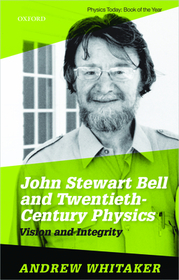
John Stewart Bell and Twentieth Century Physics
Vision and Integrity
- Publisher's listprice GBP 24.49
-
11 057 Ft (10 530 Ft + 5% VAT)
The price is estimated because at the time of ordering we do not know what conversion rates will apply to HUF / product currency when the book arrives. In case HUF is weaker, the price increases slightly, in case HUF is stronger, the price goes lower slightly.
- Discount 20% (cc. 2 211 Ft off)
- Discounted price 8 845 Ft (8 424 Ft + 5% VAT)
- Discount is valid until: 30 June 2026
Subcribe now and take benefit of a favourable price.
Subscribe
11 057 Ft

Availability
Estimated delivery time: In stock at the publisher, but not at Prospero's office. Delivery time approx. 3-5 weeks.
Not in stock at Prospero.
Why don't you give exact delivery time?
Delivery time is estimated on our previous experiences. We give estimations only, because we order from outside Hungary, and the delivery time mainly depends on how quickly the publisher supplies the book. Faster or slower deliveries both happen, but we do our best to supply as quickly as possible.
Product details:
- Publisher OUP Oxford
- Date of Publication 30 January 2020
- ISBN 9780198861263
- Binding Paperback
- No. of pages480 pages
- Size 210x139x25 mm
- Weight 584 g
- Language English 0
Categories
Short description:
The book gives a non-mathematical account of John Bell's upbringing in Belfast and his education. It describes his major contributions to quantum theory, but also his important work in the physics of accelerators, and nuclear and elementary particle physics.
MoreLong description:
This book gives a readable non-mathematical account of the upbringing, education and academic achievement of John Stewart Bell, the celebrated physicist from Belfast, who was born in 1928.
Bell has become famous for what he described as his 'hobby', analysing the fundamental aspects of quantum theory, where he clarified a long-standing debate between the two most important figures of twentieth century physics, Albert Einstein and Niels Bohr, and showed that, contrary to belief over the previous thirty years, quantum theory could be supplemented with extra 'hidden variables'. His crucial 'Bell's Theorem' or 'Bell's Inequalities' demonstrated a contradiction between quantum theory and local causality. This relation has been tested with increasing rigour over the next years, and quantum theory has triumphed. His ideas were also important in the development of quantum information theory, which covers quantum computation, quantum cryptography and quantum teleportation.
The book covers his earlier work at Harwell, where he worked on the design of accelerators, making extremely important contributions to the physics of strong focussing. He later moved to CERN in Geneva where he carried out highly significant work in the fields of elementary particles and quantum field theory. It also covers some details of Bell's personal life, including his marriage while he was at Harwell to Mary Ross, who also worked in the physics of accelerators, and also describes his career decade by decade, and sums up his importance to twentieth-century physics.
The presentation is rather fascinating and non-mathematical in nature, and some effort is made to provide a thorough but comprehensible account of any area of Bell's work, not limited to quantum theory... [the author] unveils a number of extremely valuable works on the study of accelerators, nuclear physics and the physics of elementary particles, which we now recognize to be widely neglected.
Table of Contents:
A tough start but a good one
The 1950s - Progress on All Fronts
The 1960s - The Year of Greatest Success
The 1970s - Interest Increases
Final Achievements but Final Tragedies
The Work Continues
Work of the Highest Calibre and a Fine Life

