

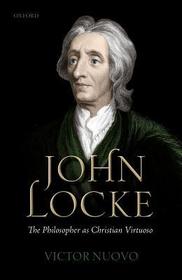
John Locke: The Philosopher as Christian Virtuoso
- Publisher's listprice GBP 88.00
-
39 732 Ft (37 840 Ft + 5% VAT)
The price is estimated because at the time of ordering we do not know what conversion rates will apply to HUF / product currency when the book arrives. In case HUF is weaker, the price increases slightly, in case HUF is stronger, the price goes lower slightly.
- Discount 10% (cc. 3 973 Ft off)
- Discounted price 35 759 Ft (34 056 Ft + 5% VAT)
Subcribe now and take benefit of a favourable price.
Subscribe
39 732 Ft

Availability
printed on demand
Why don't you give exact delivery time?
Delivery time is estimated on our previous experiences. We give estimations only, because we order from outside Hungary, and the delivery time mainly depends on how quickly the publisher supplies the book. Faster or slower deliveries both happen, but we do our best to supply as quickly as possible.
Product details:
- Publisher OUP Oxford
- Date of Publication 31 August 2017
- ISBN 9780198800552
- Binding Hardback
- No. of pages288 pages
- Size 243x177x23 mm
- Weight 558 g
- Language English 0
Categories
Short description:
Victor Nuovo represents the philosophical thought of John Locke as the work of a Christian virtuoso: an empirical natural philosopher, who was also a practising Christian. Locke believed that the two vocations were not only compatible, but mutually sustaining, and he aspired to unite them in producing a system of Christian philosophy.
MoreLong description:
Early modern Europe was the birthplace of the modern secular outlook. During the seventeenth century nature and human society came to be regarded in purely naturalistic, empirical ways, and religion was made an object of critical historical study. John Locke was a central figure in all these events. This study of his philosophical thought shows that these changes did not happen smoothly or without many conflicts of belief: Locke, in the role of Christian Virtuoso, endeavoured to resolve them. He was an experimental natural philosopher, a proponent of the so-called 'new philosophy', a variety of atomism that emerged in early modern Europe. But he was also a practising Christian, and he professed confidence that the two vocations were not only compatible, but mutually sustaining. He aspired, without compromising his empirical stance, to unite the two vocations in a single philosophical endeavour with the aim of producing a system of Christian philosophy.
Nuovo's new book makes a number of important contributions to Locke scholarship. But to my mind, one of the most important is to bring these difficult but very important questions into crystal clear focus. And while some readers might disagree with the answers he gives, it is clear that in the course of giving them he has provided us with a book of great value.
Table of Contents:
Introduction
I. Christian Virtuosity and the Crisis of Atheism
Francis Bacon and the Origin of Christian Virtuosity
Robert Boyle, Christian Virtuoso
Epicurus, Lucretius, and the Crisis of Atheism
II. The Philosophy of a Christian Virtuoso
The Origin of Locke's Essay
The Philosophy of a Christian Virtuoso I: The New Countenance of Logic
The Philosophy of a Christian Virtuoso II: Physics
The Philosophy of a Christian Virtuoso III: Ethics
The Theology of a Christian Virtuoso
Conclusion

