

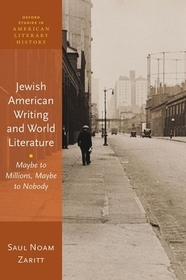
Jewish American Writing and World Literature
Maybe to Millions, Maybe to Nobody
Series: Oxford Studies in American Literary History;
- Publisher's listprice GBP 82.00
-
37 023 Ft (35 260 Ft + 5% VAT)
The price is estimated because at the time of ordering we do not know what conversion rates will apply to HUF / product currency when the book arrives. In case HUF is weaker, the price increases slightly, in case HUF is stronger, the price goes lower slightly.
- Discount 10% (cc. 3 702 Ft off)
- Discounted price 33 321 Ft (31 734 Ft + 5% VAT)
Subcribe now and take benefit of a favourable price.
Subscribe
37 023 Ft

Availability
printed on demand
Why don't you give exact delivery time?
Delivery time is estimated on our previous experiences. We give estimations only, because we order from outside Hungary, and the delivery time mainly depends on how quickly the publisher supplies the book. Faster or slower deliveries both happen, but we do our best to supply as quickly as possible.
Product details:
- Publisher OUP Oxford
- Date of Publication 13 October 2020
- ISBN 9780198863717
- Binding Hardback
- No. of pages252 pages
- Size 244x163x20 mm
- Weight 536 g
- Language English 85
Categories
Short description:
This book explores how Jewish American writers like Sholem Asch, Jacob Glatstein, Isaac Bashevis Singer, Anna Margolin, Saul Bellow, and Grace Paley think of themselves as world writers, and the successes and failures that come with this role.
MoreLong description:
Jewish American Writing and World Literature: Maybe to Millions, Maybe to Nobody studies Jewish American writers' relationships with the idea of world literature. Writers such as Sholem Asch, Jacob Glatstein, Isaac Bashevis Singer, Anna Margolin, Saul Bellow, and Grace Paley all responded to a demand to write beyond local Jewish and American audiences and toward the world, as a global market and as a transnational ideal. Beyond fame and global circulation, world literature holds up the promise of legibility, in which a threatened origin becomes the site for redemptive literary creativity. But this promise inevitably remains unfulfilled, as writers struggle to balance potential universal achievements with untranslatable realities, rendering impossible any complete arrival in the US and in the world. The work examined in this study was deeply informed by an intimate connection to Yiddish, a Jewish vernacular with its own global network and institutional ambitions. Jewish American Writing and World Literature tracks the attempts and failures, through translation, to find a home for Jewish vernacularity in the institution of world literature.
The exploration of the translational uncertainty of Jewish American writing joins postcolonial critiques of US and world literature and challenges Eurocentric and Anglo-American paradigms of literary study. In bringing into conversation the fields of Yiddish studies, American Studies, and world literature theory, Jewish American Writing and World Literature: Maybe to Millions, Maybe to Nobody proposes a new approach to the study of modern Jewish literatures and their implication within global empires of culture.
Table of Contents:
Introduction: Jewish American World Writing
A Monolingual World Literature: Sholem Asch and the Institutionalization of Yiddish Literature
A World Literature To-Come: Jacob Glatstein's Vernacular Modernism
Isaac Bashevis Singer, Translation, and Ghost World Literature
Between Heaven and Earth: Saul Bellow and the Dialectics of World Literature
Epilogue: Anna Margolin, Grace Paley, and the Politics of Listening

