

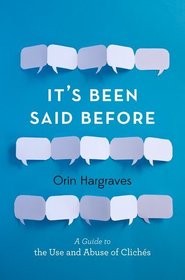
It's Been Said Before
A Guide to the Use and Abuse of Clichés
- Publisher's listprice GBP 22.99
-
10 379 Ft (9 885 Ft + 5% VAT)
The price is estimated because at the time of ordering we do not know what conversion rates will apply to HUF / product currency when the book arrives. In case HUF is weaker, the price increases slightly, in case HUF is stronger, the price goes lower slightly.
- Discount 10% (cc. 1 038 Ft off)
- Discounted price 9 341 Ft (8 897 Ft + 5% VAT)
Subcribe now and take benefit of a favourable price.
Subscribe
10 379 Ft

Availability
printed on demand
Why don't you give exact delivery time?
Delivery time is estimated on our previous experiences. We give estimations only, because we order from outside Hungary, and the delivery time mainly depends on how quickly the publisher supplies the book. Faster or slower deliveries both happen, but we do our best to supply as quickly as possible.
Product details:
- Publisher OUP USA
- Date of Publication 11 September 2014
- ISBN 9780199315734
- Binding Hardback
- No. of pages248 pages
- Size 162x243x22 mm
- Weight 494 g
- Language English 0
Categories
Short description:
In this book, Orin Hargraves provides a concise and lively guide to the most abused phrases in the English language today.
MoreLong description:
Careful writers and speakers agree that clichés are generally to be avoided. However, nearly all of us continue to use them. Why do they persist in our language?
In It's Been Said Before, lexicographer Orin Hargraves examines the peculiar idea and power of the cliché. He helps readers understand why certain phrases became clichés and why they should be avoided -- or why they still have life left in them. Indeed, clichés can be useful -- even powerful. And few people even agree on which expressions are clichés and which are not. Many regard any frequent idiom as a cliché, and a phrase regarded as a cliché in one context may be seen simply as an effective expression in another. Examples drawn from data about actual usage support Hargraves' identification of true clichés. They also illuminate his commentary on usage problems and helpful suggestions for eliminating clichés where they serve no useful purpose.
Concise and lively, It's Been Said Before serves as a guide to the most overused phrases in the English language -- and to phrases that are used exactly as often as they should be.
a very informative and entertaining book for anyone interested in the nature of development of language [...] just browsing through can potentially enhance one's passive stock of phrases so that one can speak a little more colourfully.
Table of Contents:
Introduction
1. Adjectival Clichés: Clichés that modify nouns or serve as predicates after linking verbs
2. Adverbial Clichés: Clichés that function as adverbials, describing how, when, with what, in what manner, etc.
3. People, Places, and Things: Clichés that function as noun phrases
4. Framing Devices: Clichés used to introduce, contextualize, or conclude questions or statements
5. Modifier Abuse: Clichés arising from extremely frequent and/or inapt collocation of particular adjectives with nouns, or of submodifying adverbs with adjectives
6. Predicate Clichés: Clichés beginning with a finite verb that serve as complete predicates
7. Quantification: Clichés that characterize quantities
8. Situational Clichés: Clichés consisting of complete sentences that characterize a situation or action
9. Clichés About Clichés: ways that people talk about or mention clichés that are themselves clichés
10. Appendix I: joined by "and" clichés: numerous phrases consisting of words joined by 'and'

