

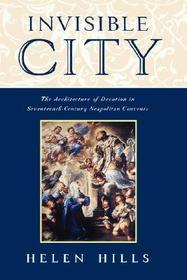
Invisible City
The Architecture of Devotion in Seventeenth Century Neapolitan Convents
- Publisher's listprice GBP 110.00
-
52 552 Ft (50 050 Ft + 5% VAT)
The price is estimated because at the time of ordering we do not know what conversion rates will apply to HUF / product currency when the book arrives. In case HUF is weaker, the price increases slightly, in case HUF is stronger, the price goes lower slightly.
- Discount 10% (cc. 5 255 Ft off)
- Discounted price 47 297 Ft (45 045 Ft + 5% VAT)
Subcribe now and take benefit of a favourable price.
Subscribe
52 552 Ft

Availability
printed on demand
Why don't you give exact delivery time?
Delivery time is estimated on our previous experiences. We give estimations only, because we order from outside Hungary, and the delivery time mainly depends on how quickly the publisher supplies the book. Faster or slower deliveries both happen, but we do our best to supply as quickly as possible.
Product details:
- Publisher OUP USA
- Date of Publication 12 February 2004
- ISBN 9780195117745
- Binding Hardback
- No. of pages320 pages
- Size 160x234x27 mm
- Weight 596 g
- Language English
- Illustrations 30pp halftone plates & 8pp colour plates 0
Categories
Short description:
Invisible City analyzes conventual architecture in terms of the politics of sight, "the optics of power", the relationship between flesh and stone. It uncovers the connections between the bodies of the nuns and the walls that housed them, presenting the architecture of female convents as a metaphor for the body of the aristocratic female virgin nun.
MoreLong description:
More than any other European city, Baroque Naples was dominated by convents. Behind their imposing facades and highly decorated churches, the convents of Naples housed the daughters of the city's most exclusive families, women who, despite their cloistered existence, were formidable players in the city's power structure. Invisible City vividly portrays the religious world of seventeenth-century Naples, a city of familial and internecine rivalries, of religious devotion and intense urban politics, of towering structures built to house the virgin daughters of the aristocracy. Helen Hills demonstrates how the architecture of the convents and the nuns' bodies they housed existed both in parallel and in opposition to one another. She discusses these women as subjects of enclosure, as religious women, and as art patrons, but also as powerful agents whose influence extended beyond the convent walls. Though often ensconced in convents owing to their families' economic circumstances, many of these young women were able to extend their influence as a result of the role convents played both in urban life and in art patronage. The convents were rich and powerful organizations, riven with feuds and prey to the ambitions of viceregal and elite groups, which their thick walls could not exclude. Even today, Neapolitan convents figure prominently in the city's fabric. In analyzing the architecture of these august institutions, Helen Hills skillfully reads conventual architecture as a metaphor for the body of the aristocratic virgin nun, mapping out the dialectic between flesh and stone.
Hills' extraordinary study is a nuanced and innovative incarnation of the secular city from its sacred recesses that should have broad appeal and wide-ranging influence. Invisible City is a brilliant, stunning book.

