
• Contact

  • Newsletter

  • About us

  • Delivery options

  • Prospero Book Market Podcast

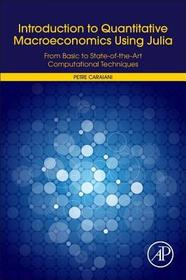
  • Introduction to Quantitative Macroeconomics Using Julia: From Basic to State-of-the-Art Computational Techniques

    Introduction to Quantitative Macroeconomics Using Julia by Caraiani, Petre;

    From Basic to State-of-the-Art Computational Techniques

      • GET 10% OFF

      • The discount is only available for 'Alert of Favourite Topics' newsletter recipients.
      • Publisher's listprice EUR 78.95
      • The price is estimated because at the time of ordering we do not know what conversion rates will apply to HUF / product currency when the book arrives. In case HUF is weaker, the price increases slightly, in case HUF is stronger, the price goes lower slightly.

        32 744 Ft (31 185 Ft + 5% VAT)
      • Discount 10% (cc. 3 274 Ft off)
      • Discounted price 29 470 Ft (28 067 Ft + 5% VAT)

    32 744 Ft

    db

    Availability

    printed on demand

    Why don't you give exact delivery time?

    Delivery time is estimated on our previous experiences. We give estimations only, because we order from outside Hungary, and the delivery time mainly depends on how quickly the publisher supplies the book. Faster or slower deliveries both happen, but we do our best to supply as quickly as possible.

    Product details:

    • Publisher Academic Press
    • Date of Publication 29 August 2018

    • ISBN 9780128122198
    • Binding Paperback
    • No. of pages238 pages
    • Size 276x216 mm
    • Weight 680 g
    • Language English
    • 0

    Categories

    Long description:

    Introduction to Quantitative Macroeconomics Using Julia: From Basic to State-of-the-Art Computational Techniques facilitates access to fundamental techniques in computational and quantitative macroeconomics. It focuses on the recent and very promising software, Julia, which offers a MATLAB-like language at speeds comparable to C/Fortran, also discussing modeling challenges that make quantitative macroeconomics dynamic, a key feature that few books on the topic include for macroeconomists who need the basic tools to build, solve and simulate macroeconomic models. This book neatly fills the gap between intermediate macroeconomic books and modern DSGE models used in research.


    • Combines an introduction to Julia, with the specific needs of macroeconomic students who are interested in DSGE models and PhD students and researchers interested in building DSGE models
    • Teaches fundamental techniques in quantitative macroeconomics by introducing theoretical elements of key macroeconomic models and their potential algorithmic implementations
    • Exposes researchers working in macroeconomics to state-of-the-art computational techniques for simulating and solving DSGE models


    "The book is one of the few books written for economists having expertise in mathematics. The book focuses mainly on computational aspects of macroeconomics from the perspective of ‘Julia’. In this book the author has left a long lasting impact on important mathematical foundations of macroeconomics. This process makes the book self sufficient to use Julia in macroeconomics.... Now, if I have to write about the weakness of the book, then I suggest to include a few separate chapters on basic macroeconomics in this book. These chapters will make this book self sufficient from the perspective of mathematicians, statisticians, computer scientists, etc. Moreover, these basic chapters will also attract their attentions on macroeconomics from the perspective of Julia and the book will have readers from interdisciplinary areas. At the end, I would like to congratulate the author for writing a book on a programming language ‘Julia’ which has been gaining its applicability slowly. The book will have long run impact in the area of computational macroeconomics. Thus, this book is highly recommended for undergraduate students, graduate students, researchers, etc. those who want to learn and apply new programming language ‘Julia’ in their research activities of macroeconomics and allied areas. Overall, this book must be considered as an extraordinary and most useful book for Julia." --zbMath/European Mathematical Society and the Heidelberg Academy of Sciences and Humanities

    "A concise and elegant introduction to many of the topics involved in the solution of dynamic macroeconomic models. Caraiani 's use of Julia is a fantastic choice for teaching modern numerical methods." --Jesus Fernandez-Villaverde, University of Pennsylvania

    "Julia is a computer language that is taking economics by storm. In this book, Petre Caraiani takes the reader by their hands and introduce them to a wide variety of numerical methods that are then applied to recent macroeconomic models. The book explains these methods and applies them in Julia not only those models with representative-agent (RBC and DSGE models), but also to heterogeneous-agents models. Therefore, the book is a valuable source for readers interested in numerical methods and in Julia." --Pedro Garcia Duarte, University of São Paulo

    "Petre Caraiani’s book guides the readers into the sophisticated and innovative field of quantitative macroeconomics with the aim of bridging the gap between theoretical models and modern computational techniques. Caraiani provides an outstandingly clear exposition of the numerical methods by which researchers and graduate students can approach the complex problems of solving DSGE models or setting up heterogeneous agents models. This book is a must for all those who are interested in making theoretical macroeconomics an empirical discipline." --Peter Galbács, Budapest Business School

    "This book provides an excellent overview of key numerical tools to study macroeconomic models and provides supporting programs using Julia, a frontier programming language." --Wouter den Haan, London School of Economics

    "This book provides a clear and comprehensive introduction to the numerical techniques that every student that aims at doing quantitative economics should know. Not only the book provides with a minimal introduction to the theory underlying these methods, but it also offers many examples, all coded in a modern language, Julia. This book is definitely a good reference for whoever needs a quick and nice introduction to these techniques." --Fabrice Collard, University of Bern

    More

    Table of Contents:

    1. Introduction to Julia2. Basic Numerical Techniques3. Solving and Simulating DSGE Models4. Dynamic Programming5. Advanced Numerical Techniques6. Heterogeneous Agents Models

    More
    0