

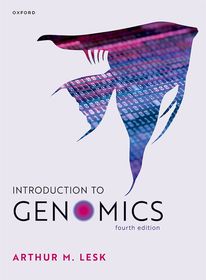
Introduction to Genomics
- Publisher's listprice GBP 55.99
-
25 279 Ft (24 075 Ft + 5% VAT)
The price is estimated because at the time of ordering we do not know what conversion rates will apply to HUF / product currency when the book arrives. In case HUF is weaker, the price increases slightly, in case HUF is stronger, the price goes lower slightly.
- Discount 10% (cc. 2 528 Ft off)
- Discounted price 22 751 Ft (21 668 Ft + 5% VAT)
Subcribe now and take benefit of a favourable price.
Subscribe
25 279 Ft

Availability
Estimated delivery time: In stock at the publisher, but not at Prospero's office. Delivery time approx. 3-5 weeks.
Not in stock at Prospero.
Why don't you give exact delivery time?
Delivery time is estimated on our previous experiences. We give estimations only, because we order from outside Hungary, and the delivery time mainly depends on how quickly the publisher supplies the book. Faster or slower deliveries both happen, but we do our best to supply as quickly as possible.
Product details:
- Edition number 4
- Publisher OUP Oxford
- Date of Publication 17 April 2025
- ISBN 9780198866893
- Binding Paperback
- No. of pages624 pages
- Size 267x216x25 mm
- Weight 1164 g
- Language English 979
Categories
Short description:
The most up-to-date and complete textbook for first time genomics students, Introduction to Genomics offers a fascinating insight into how organisms differ or match; how different organisms evolved; how the genome is constructed and how it operates; and what our understanding of genomics means in terms of our future health and wellbeing.
MoreLong description:
Our genome is the blueprint for our existence: it encodes all the information we need to develop from a single cell into a hugely complicated functional organism. Yet it is more than a static information store: our genome is a dynamic, tightly regulated collection of genes, which switch on and off in many combinations to give the variety of cells from which our bodies are formed. But how do we identify the genes that make up our genome? How do we determine their function? And how do different genes form the regulatory networks that direct the processes of life?
Introduction to Genomics is the most up-to-date and complete textbook for students approaching the subject for the first time. Lesk's engaging writing style brings a narrative to a disparate field of study and offers a fascinating insight into what can be revealed from the study of genomes. The book covers: the similarities and differences between organisms; how different organisms evolved; how the genome is constructed and how it operates; and what our understanding of genomics means in terms of our future health and wellbeing.
Digital formats and resources
The book is available for students and institutions to purchase in a variety of formats, and is supported by online resources:
· The e-book offers a mobile-compatible experience and convenient access along with functionality tools, navigation features, and links that offer extra learning support: www.oxfordtextbooks.co.uk/ebooks
· Online resources, available for registered adopters, include downloadable figures and tables from the book
· E-book and Trove formats are enriched with online resources for students, including extensive and imaginative weblems (web-based problems) for each chapter; hints and answers to end-of-chapter problems and exercises to support self-directed learning; a guided tour of websites and major archival databanks in genomics to springboard further research; Journal Club (links to related research articles on topics covered in the book paired with engaging questions); and rotating figures which allow readers to visualize complex structures.
Review from previous edition
This book is great for introducing the field of genomics, providing the basic concepts underpinning the field, including cutting edge techniques, along with examples of its application.
Table of Contents:
Introduction and background
The Human Genome Project: achievements and applications
Bioinformatics
Classical genetics, mapping and sequencing
Evolution and genomic change
Comparative genomics
Genomes of prokaryotes and viruses
Genomes of eukaryotes
Genomics and anthropology: human evolution, Migration, and domestication of plants and animals
The impact of genomics on human health and disease
Transcriptomics
Proteomics
Metabolomics
Systems biology

