

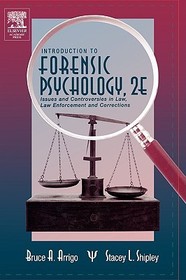
Introduction to Forensic Psychology
Issues and Controversies in Crime and Justice
- Publisher's listprice EUR 55.95
-
21 854 Ft (20 813 Ft + 5% VAT)
The price is estimated because at the time of ordering we do not know what conversion rates will apply to HUF / product currency when the book arrives. In case HUF is weaker, the price increases slightly, in case HUF is stronger, the price goes lower slightly.
- Discount 10% (cc. 2 185 Ft off)
- Discounted price 19 668 Ft (18 732 Ft + 5% VAT)
Subcribe now and take benefit of a favourable price.
Subscribe
21 854 Ft

Availability
Out of print
Why don't you give exact delivery time?
Delivery time is estimated on our previous experiences. We give estimations only, because we order from outside Hungary, and the delivery time mainly depends on how quickly the publisher supplies the book. Faster or slower deliveries both happen, but we do our best to supply as quickly as possible.
Product details:
- Edition number 2
- Publisher Elsevier Science
- Date of Publication 24 December 2004
- ISBN 9780120643516
- Binding Hardback
- No. of pages600 pages
- Size 228x152 mm
- Weight 1090 g
- Language English 0
Categories
Long description:
Introduction to Forensic Psychology, Second Edition is an original approach to understanding how psychologists impact the research, practice, and policy of crime, law, and justice. Divided into four sections on criminal forensics, civil forensics, policing and law enforcement, and corrections and prison practices, the text examines police, court, and correctional aspects of forensic psychology. Each of the twelve chapters are organized around relevant case illustrations, include comprehensive literature reviews, and discuss policy implications and avenues of future research. Each chapter additionally incorporates research on race, gender, and class, as well as including a practice update, highlighting a timely issue or controversy.
The text thoughtfully explores a wide range of adult, juvenile, family, and community themes of interest to students, practitioners, and administrators. New to the Second Edition is a chapter on international criminal forensic psychology, and sections on assessing psychiatric work-related disability, termination of parental rights, counseling prison populations, malingering, crisis intervention in prisons/jails, and child custody evaluations. Suitable as a primary text for courses on psychology and criminal justice, the book may also serve as a reference tool for practicing forensic psychologists.
Table of Contents:
Part I: Court and the Legal Systems: Criminal Forensics.
Adult Forensics.
Juvenile/Family Forensics.
International Criminal Forensics.
Adult Forensics.
PART II: Court and Legal System: Civil Forensics.
Adult Forensics.
Juvenile Forensics.
Family Forensics.
PART III: Police and Law Enforcement.
Adult Issues in Policing/Psychology.
Juvenile Issues in Policing/Psychology.
Family/Community Issues in Policing/Psychology.
Part IV: Corrections and Prison Practices.
Adult Issues in Corrections/Correctional Psychology.
Juvenile Issues in Corrections/Correctional Psychology.
Family/Community Issues in Corrections/Correctional Psychology.

