

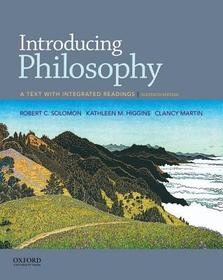
Introducing Philosophy
A Text with Integrated Readings
- Publisher's listprice GBP 58.00
-
27 709 Ft (26 390 Ft + 5% VAT)
The price is estimated because at the time of ordering we do not know what conversion rates will apply to HUF / product currency when the book arrives. In case HUF is weaker, the price increases slightly, in case HUF is stronger, the price goes lower slightly.
- Discount 10% (cc. 2 771 Ft off)
- Discounted price 24 939 Ft (23 751 Ft + 5% VAT)
Subcribe now and take benefit of a favourable price.
Subscribe
27 709 Ft

Availability
Uncertain availability. Please turn to our customer service.
Why don't you give exact delivery time?
Delivery time is estimated on our previous experiences. We give estimations only, because we order from outside Hungary, and the delivery time mainly depends on how quickly the publisher supplies the book. Faster or slower deliveries both happen, but we do our best to supply as quickly as possible.
Product details:
- Edition number 11
- Publisher OUP USA
- Date of Publication 1 November 2015
- ISBN 9780190209452
- Binding Paperback
- No. of pages736 pages
- Size 254x203 mm
- Language English 0
Categories
Long description:
Introducing Philosophy: A Text with Integrated Readings, Eleventh Edition, is an exciting, accessible, and thorough introduction to the core questions of philosophy and the many ways in which they are, and have been, answered. The authors combine substantial selections from significant works in the history of philosophy with excerpts from current philosophy, clarifying the readings and providing context with their own detailed commentary and explanation.
Spanning 2,500 years, the selections range from the oldest known fragments to cutting-edge contemporary essays. Organized topically, the chapters present alternative perspectives?including analytic, continental, feminist, and non-Western viewpoints?alongside the historical works of major Western philosophers.
Introducing Philosophy's greatest strength is its vast, comprehensive scope. In most of its chapters it generally leaves no stone unturned, moving from Greco-Roman antiquity all the way to the living present, and incorporating elements from literary, theological, and Eastern religious-philosophic traditions.
Table of Contents:
*=New to this Edition
INTRODUCTION
A. Socrates
Aristophanes, from The Clouds
Plato, from The Apology; from The Crito; from The Phaedo; from The Republic
B. What Is Philosophy?
Plato, from The Apology
Karl Jaspers, from "The 'Axial Period'"
Laozi, from Dao De Jing
C. A Modern Approach to Philosophy
René Descartes, from Discourse on Method
D. A Brief Introduction to Logic
Key Terms
Bibliography and Further Reading
PART ONE. THE WORLD AND BEYOND
CHAPTER 1. REALITY
A. "The Way the World Really Is"
Aristotle, from Metaphysics
B. The First Greek Philosophers
Parmenides, from Fragments
C. Ultimate Reality in the East: India, Persia, and China
From Upanishads
From Zend-Avesta
From The Confucian Analects
Laozi, from Dao De Jing
Buddha, from "Fire-Sermon"
D. Two Kinds of Metaphysics: Plato and Aristotle
Plato, from The Symposium; from The Republic; from The Meno
Aristotle, from Metaphysics; from Physics; from Metaphysics
E. Modern Metaphysics
René Descartes, On Substance; from "Meditation VI"
Benedictus de Spinoza, from Ethics
Gottfried Wilhelm von Leibniz, from Monadology
* David Lewis, From Counterfactuals
Martin Heidegger, from "The Fundamental Question of Metaphysics"
CHAPTER 2. RELIGION
A. What Is Religion?
John Wisdom, from "Gods"
Albert Einstein, On the Design of the Universe
Keiji Nishitani, from "What Is Religion?"
B. The Western Religions
C. Proving God: The Ontological Argument
St. Anselm, On The Ontological Argument
René Descartes, On the Ontological Argument
Immanuel Kant, Against the Ontological Argument
D. God as Creator: Intelligence and Design
St. Thomas Aquinas, Five Arguments for the Existence of God
William Paley, From "The Watch and the Watchmaker"
St. Thomas Aquinas, On the "Fifth Way"
David Hume, from Dialogues on Natural Religion
* Cory Juhl, On the Fine-Tuning Argument
E. Religion, Morality, and Evil
Immanuel Kant, On God and Morality
William James, from "The Will to Believe"
Blaise Pascal, "The Wager"
St. Augustine, from Confessions
From The Bhagavadgita
F. Beyond Reason: Faith and Irrationality
Mohammad al-Ghazali, from The Deliverance from Error
Soren Kierkegaard, On Subjective Truth
Paul Tillich, On the Ultimate Concern
G. Doubts about God and Religion
Fyodor Dostoyevsky, from The Brothers Karamazov
Karl Marx, from Critique of Hegel's Philosophy of Right
Friedrich Nietzsche, from Beyond Good and Evil; from The Antichrist; from The Gay Science
Sigmund Freud, from The Future of an Illusion
* Mary Daly, "Wanted: God or Goddess?"
* Victor A. Gunasekara, "The Buddhist Attitude to God"
CHAPTER 3. KNOWLEDGE
Bertrand Russell, from The Problems of Philosophy
* Plato, from The Republic
Plato, from Theatetus
A. The Rationalist's Confidence: Descartes
René Descartes, from "Meditation I"; from "Meditation II"; from "Meditation VI"
B. Innate Ideas Concerning Human Understanding: John Locke
John Locke, from An Essay Concerning Human Understanding
Gottfried Wilhelm von Leibniz, from New Essays on Human Understanding
C. Two Empiricist Theories of Knowledge
John Locke, from An Essay Concerning Human Understanding
Bishop George Berkeley, from Treatise Concerning the Principles of Human Knowledge
D. The Congenial Skeptic: David Hume
David Hume, from A Treatise of Human Nature; from An Enquiry Concerning Human Understanding
* E. A CONTEMPORARY CONUNDRUM: KNOWLEDGE AS JUSTIFIED TRUE BELIEF
CHAPTER 4.TRUTH & RELATIVISM
A.What Is Truth?
B.Theories of Truth
* Brand Blanshard, from The Nature of Thought
* Charles Peirce, from "How to Make Our Ideas Clear"
* William James, from Pragmatism: A New Name for Some Old Ways of Thinking.
* Alfred Tarski, from "The Semantic Theory of Truth"
C. Kant's Revolution
Immanuel Kant, from The Critique of Pure Reason; from Prolegomena to Any Future Metaphysics
D. The Battle in Europe After Kant: Relativism and Absolutism
G. W. F. Hegel, from The Phenomenology of Spirit; from Reason in History
Arthur Schopenhauer, from The World as Will and Representation
Friedrich Nietzsche, On Truth
E. Phenomenology
Edmund Husserl, from "Philosophy as Rigorous Science"; from The 1929 Paris Lectures
F. Hermeneutics and Pragmatism: Relativism Reconsidered
Richard Rorty, from "Solidarity or Objectivity?"
Isamu Nagami, from "Cultural Gaps: Why Do We Misunderstand?"
G. The Analytic Turn
Bertrand Russell, from The Problems of Philosophy
W. V. O. Quine, from "Epistemology Naturalized"
H. Feminist Epistemology
Elizabeth Grosz, On Feminist Knowledge
Uma Narayan, On Feminist Epistemology
PART TWO. KNOW THYSELF
CHAPTER 5. MIND AND BODY
A. What Is Consciousness?
René Descartes, from "Meditation VI"; from "Meditation III"; from "Meditation VI"
B. The Problem of Dualism
René Descartes, from "The Passions of the Soul"
C. The Rejection of Dualism
Gilbert Ryle, from The Concept of Mind
J. J. C. Smart, from "Sensations and Brain Processes"
Jerome Shaffer, Against the Identity Theory
Paul M. Churchland, On Eliminative Materialism
David Braddon-Mitchell and Frank Jackson, from Philosophy of Mind and Cognition
John R. Searle, from "The Myth of the Computer"; from Minds, Brains, and Science
D. The Problem of Consciousness
Sigmund Freud, On the "Unconscious"
Thomas Nagel, from Mortal Questions
Aristotle, from De Anima
Galen Strawson, On "Cognitive Experience"
* Elizabeth V. Spelman, from "Woman as Body: Ancient and Contemporary Views"
CHAPTER 6. SELF
A. Consciousness and the Self: From Descartes to Kant
René Descartes, from "Meditation VI"
John Locke, On Personal Identity
David Hume, On "There Is No Self"
Immanuel Kant, Against the Soul
Meredith Michaels, On "Personal Identity"
* Derek Parfit, from Reasons and Persons
B. Existentialism: Self-Identity and the Responsibility of Choice
Jean-Paul Sartre, On Existentialism; * On Bad Faith; from No Exit
C. The Individual and the Community
Soren Kierkegaard, On "The Public"; On Self and Passion
Martin Heidegger, On "Dasein" and the "They"
David Reisman, On Individualism
Malcolm X, On Being "African"; from "At the Audubon"
Sherry Ortner, from "Is Female to Male as Nature Is to Culture?"
Ann Ferguson, On Androgyny
* Dierdre McClosky, from Crossing
D. One Self? Any Self? Questioning the Concept of Personal "Essence"
Hermann Hesse, from Steppenwolf
Luce Irigaray, from This Sex Which Is Not One
Genevieve Lloyd, from "The Man of Reason"
From The Dhammapada
Laozi, from Dao De Jing
CHAPTER 7. FREEDOM
A. Fatalism and Karma
Sophocles, from Oedipus the King
Keiji Nishitani, On Fate
B. Predestination
St. Augustine, from On Free Choice of the Will
Muhammad Iqbal, from The Reconstruction of Religious Thought in Islam
Jacqueline Trimier, on the Yoruba Ori
Jonathan Edwards, from "Freedom of the Will"
C. Determinism
Baron Paul Henri d'Holbach, from System of Nature
Daniel Dennett, from Elbow Room
Robert Kane, On Indeterminism
John Stuart Mill, On Causation and Necessity
David Hume, On Causation and Character
Robert Kane, On "Wiggle Room"
Harry Frankfurt, from "Freedom of the Will and the Concept of a Person"
D. Compulsion and Ignorance
Aristotle, On Voluntary Action
Judith Orr, "Sex, Ignorance, and Freedom"
John Hospers, from "What Means This Freedom?"
B. F. Skinner, Beyond Freedom
B. F. Skinner, from Walden Two
Robert Kane, Beyond Skinner
Anthony Burgess, from A Clockwork Orange
Catherine MacKinnon, On Coercion of Women's Sexuality
E. Freedom in Practice: Kant's Solution
F. Radical Freedom: Existentialism
Jean-Paul Sartre, On "Absolute Freedom"
Fyodor Dostoyevsky, from "The Most Advantageous Advantage"
Thich Nhat Hanh, from "Turning on the Television"
PART THREE. THE GOOD AND THE RIGHT
CHAPTER 8. ETHICS
A. Morality
B. Is Morality Relative?
Gilbert Harman, from "Moral Relativism Defended"
St. Thomas Aquinas, from The Summa Theologica
John Corvino, from Same Sex: Debating the Ethics, Science, and Culture of Homosexuality
C. Egoism and Altruism
Plato, from The Republic
* Tara Smith, On the Necessity of Egoism (Ayn Rand)
D. Are We Naturally Selfish? A Debate
Mencius, On Human Nature: Man Is Good
Xunzi, from "Human Nature Is Evil"
Joseph Butler, Against Egoism
E. Morality as Virtue: Aristotle
Aristotle, from The Nicomachean Ethics
F. Morality and Sentiment: Hume and Rousseau
David Hume, On "Reason as Slave of the Passions"
Jean-Jacques Rousseau, from Émile
G. Morality and Practical Reason: Kant
Immanuel Kant, from Fundamental Principles of the Metaphysics of Morals
H. Utilitarianism
Jeremy Bentham, from An Introduction to the Principles of Morals and Legislation
John Stuart Mill, from Utilitarianism
I. The Creation of Morality: Nietzsche and Existentialism
Friedrich Nietzsche, On "Morality as Herd-Instinct"; On "Master and Slave Morality"
Jean-Paul Sartre, from Existentialism as a Humanism
* Simone de Beauvoir, from The Ethics of Ambiguity
J. Ethics and Gender
Virginia Held, On Feminist Ethics
CHAPTER 9. JUSTICE
A. The Problem of Justice
B. Two Ancient Theories of Justice: Plato and Aristotle
Plato, from The Republic
Aristotle, from The Nicomachean Ethics
C. Two Modern Theories of Justice: Hume and Mill on Utility and Rights
David Hume, on "Justice and Utility"
John Stuart Mill, from Utilitarianism
D. The Social Contract
Thomas Hobbes, from Leviathan
Jean-Jacques Rousseau, from The Social Contract
Thomas Jefferson et al., from The Declaration of Independence
E. Fairness and Entitlement
John Rawls, from "Justice as Fairness"
Robert Nozick, from Anarchy, State, and Utopia
F. Justice or Care: A Feminist Perspective
Cheshire Calhoun, from "Justice, Care, Gender Bias"
* María Lugones, from "Playfulness, World-Traveling, and Loving Perception"
G. Individual Rights and Freedom
John Locke, from The Second Treatise on Government; from On Liberty
Malcolm X, On Civil and Human Rights
Amartya Sen, from "Property and Hunger"
H. Fighting for Rights and Justice: Civil Disobedience
Henry David Thoreau, from "Resistance to Civil Government" ("Civil Disobedience")
Martin Luther King, Jr., from "Letter from Birmingham Jail"

