

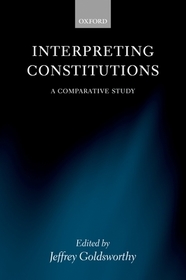
Interpreting Constitutions
A Comparative Study
- Publisher's listprice GBP 105.00
-
47 407 Ft (45 150 Ft + 5% VAT)
The price is estimated because at the time of ordering we do not know what conversion rates will apply to HUF / product currency when the book arrives. In case HUF is weaker, the price increases slightly, in case HUF is stronger, the price goes lower slightly.
- Discount 10% (cc. 4 741 Ft off)
- Discounted price 42 667 Ft (40 635 Ft + 5% VAT)
Subcribe now and take benefit of a favourable price.
Subscribe
47 407 Ft

Availability
printed on demand
Why don't you give exact delivery time?
Delivery time is estimated on our previous experiences. We give estimations only, because we order from outside Hungary, and the delivery time mainly depends on how quickly the publisher supplies the book. Faster or slower deliveries both happen, but we do our best to supply as quickly as possible.
Product details:
- Publisher OUP Oxford
- Date of Publication 9 February 2006
- ISBN 9780199274130
- Binding Hardback
- No. of pages384 pages
- Size 242x164x26 mm
- Weight 720 g
- Language English 0
Categories
Short description:
This book describes the constitutions of six major federations and how they have been interpreted by their highest courts, compares the interpretive methods that have guided the courts, and explores the reasons for major differences between these methods. Each of the six federations is the subject of a separate chapter written by a leading authority, which describes not only the interpretive methodology currently used, but the evolution of that methodology since the constitution in question was first enacted. The book also includes a concluding chapter that compares these methodologies, and attempts to explain variations by reference to different social, historical, institutional and political circumstances.
MoreLong description:
This book describes the constitutions of six major federations and how they have been interpreted by their highest courts, compares the interpretive methods and underlying principles that have guided the courts, and explores the reasons for major differences between these methods and principles.
Among the interpretive methods discussed are textualism, purposivism, structuralism and originalism. Each of the six federations is the subject of a separate chapter written by a leading authority in the field: Jeffrey Goldsworthy (Australia), Peter Hogg (Canada), Donald Kommers (Germany), S.P. Sathe (India), Heinz Klug (South Africa), and Mark Tushnet (United States). Each chapter describes not only the interpretive methodology currently used by the courts, but the evolution of that methodology since the constitution was first enacted. The book also includes a concluding chapter which compares these methodologies, and attempts to explain variations by reference to different social, historical, institutional and political circumstances.
Table of Contents:
Introduction
United States: Eclecticism In the Service of Pragmatism
Canada: From Privy Council to Supreme Court
Australia: Devotion to Legalism
Germany: Balancing Rights and Duties
India: From Positivism to Structuralism
South Africa: From Constitutional Promise to Social Transformation
Conclusions
Index

