

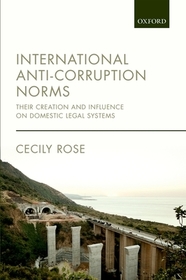
International Anti-Corruption Norms
Their Creation and Influence on Domestic Legal Systems
- Publisher's listprice GBP 147.50
-
66 596 Ft (63 425 Ft + 5% VAT)
The price is estimated because at the time of ordering we do not know what conversion rates will apply to HUF / product currency when the book arrives. In case HUF is weaker, the price increases slightly, in case HUF is stronger, the price goes lower slightly.
- Discount 10% (cc. 6 659 Ft off)
- Discounted price 59 937 Ft (57 083 Ft + 5% VAT)
Subcribe now and take benefit of a favourable price.
Subscribe
66 596 Ft

Availability
printed on demand
Why don't you give exact delivery time?
Delivery time is estimated on our previous experiences. We give estimations only, because we order from outside Hungary, and the delivery time mainly depends on how quickly the publisher supplies the book. Faster or slower deliveries both happen, but we do our best to supply as quickly as possible.
Product details:
- Publisher OUP Oxford
- Date of Publication 13 August 2015
- ISBN 9780198737216
- Binding Hardback
- No. of pages282 pages
- Size 240x169x22 mm
- Weight 578 g
- Language English 0
Categories
Short description:
With corruption at the forefront of the international political debate, this timely book analyses the international regulation of corruption, assesses the core international instruments governing anti-corruption efforts, and considers the concept of legitimacy as a framework for evaluating anti-corruption norms.
MoreLong description:
This book traces the creation of international anti-corruption norms by states and other actors through four markedly different institutions: the Organisation for Economic Co-operation and Development, the United Nations, the Extractive Industries Transparency Initiative, and the Financial Action Task Force. Each of these institutions oversees an international instrument that requires states to combat corruption. Yet, only the United Nations oversees anti-corruption norms that take the sole form of a binding multilateral treaty. The OECD has, by contrast, fostered the development of the binding 1997 OECD Anti-Bribery Convention, as well as non-binding recommendations and guidance associated with treaty itself. In addition, the revenue transparency and anti-money laundering norms developed through the Extractive Industries Transparency Initiative and the Financial Action Task Force, respectively, take the form of non-binding instruments that have no relationship with multilateral treaties.
The creation of international anti-corruption norms through non-binding instruments and informal institutions has the potential to privilege the interests of powerful states in ways that raise questions about the normative legitimacy of these institutions and the instruments they produce. At the same time, the anti-corruption instruments created under the auspices of these institutions also show that non-binding instruments and informal institutions carry significant advantages. The non-binding instruments in the anti-corruption field have demonstrated a capacity to influence domestic legal systems that is comparable to, if not greater than, that of binding treaties.
With corruption and money laundering at the forefront of political debate, International Anti-Corruption Norms provides timely expertise on how states and international institutions grapple with these global problems.
Table of Contents:
Introduction
International Anti-Corruption Instruments Viewed Through the Lenses of Soft Law and Legitimacy
The Domestic Influence of the OECD Anti-Bribery Convention and the Working Group on Bribery
The Limitations of the United Nations Convention Against Corruption
The Extractive Industries Transparency Initiative: Targeting Corruption Through Revenue Transparency Norms
The Financial Action Task Force as the Norm-Creator in the Anti-Money Laundering Field
Conclusion

