

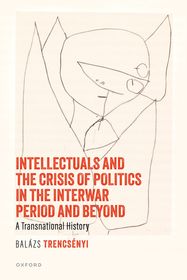
Intellectuals and the Crisis of Politics in the Interwar Period and Beyond
A Transnational History
- Publisher's listprice GBP 99.00
-
44 698 Ft (42 570 Ft + 5% VAT)
The price is estimated because at the time of ordering we do not know what conversion rates will apply to HUF / product currency when the book arrives. In case HUF is weaker, the price increases slightly, in case HUF is stronger, the price goes lower slightly.
- Discount 20% (cc. 8 940 Ft off)
- Discounted price 35 759 Ft (34 056 Ft + 5% VAT)
- Discount is valid until: 30 June 2026
Subcribe now and take benefit of a favourable price.
Subscribe
44 698 Ft

Availability
Estimated delivery time: In stock at the publisher, but not at Prospero's office. Delivery time approx. 3-5 weeks.
Not in stock at Prospero.
Why don't you give exact delivery time?
Delivery time is estimated on our previous experiences. We give estimations only, because we order from outside Hungary, and the delivery time mainly depends on how quickly the publisher supplies the book. Faster or slower deliveries both happen, but we do our best to supply as quickly as possible.
Product details:
- Publisher OUP Oxford
- Date of Publication 19 March 2025
- ISBN 9780198929482
- Binding Hardback
- No. of pages336 pages
- Size 240x162x23 mm
- Weight 598 g
- Language English 698
Categories
Short description:
This book provides a comprehensive analysis of modern European crisis discourses from the interwar period through to the present day.
MoreLong description:
This volume offers a broad-ranging and comprehensive analysis of the history and theory of the political idea of 'crisis', from the interwar period through to the present day. It considers how the multiple crises of civilization, capitalism, social cohesion, liberalism, democracy, socialism, and the nation-state were conceptualized; how these spheres of crisis became entangled; and who the intellectuals, politicians and experts were who employed these discourses.
Intellectuals and the Crisis of Politics in the Interwar Period and Beyond maps the range of meanings the term 'crisis' has borne and the roles it has performed across disciplines and countries, de-centering the dominant narrative that takes Western European positions and developments as normative. It especially focuses on the historical roots of two key contemporary contesters of liberal democracy: neoliberalism and populism, and presents an innovative analysis of the roots of contemporary illiberalism in Europe.
Bringing these ideas into the present day, Balázs Trencsényi offers ideas on how a reflective and self-critical liberal democratic political position could be defined and defended in our current predicament, which is increasingly compared to the interwar period and is often described as a “polycrisis”.
In view of the inflation of crisis discourses since the global financial crisis, Trencsényi soberly states: "The disintegration of the liberal democratic synthesis becomes increasingly imaginable." His brilliant intellectual history of the interwar period thus provides orientation knowledge in a time whose complexity is particularly surprising to those who have never dealt with the 1920s and 1930s.
Table of Contents:
Introduction: The Faces of Crisis
The Morphology of Modern Crisis Discourses
Crisis of the Mind and Spirit
Crisis of Capitalism
Crisis of Social Cohesion
Crisis of Liberalism
Crisis of Democracy
Crisis of Socialism
Crisis of the Nation-State and the International System
Long Shadows of the Interwar Crises
Conclusion: The Politics of Crisis
Select Bibliography
Index

