

- Publisher's listprice EUR 99.95
-
39 040 Ft (37 181 Ft + 5% VAT)
The price is estimated because at the time of ordering we do not know what conversion rates will apply to HUF / product currency when the book arrives. In case HUF is weaker, the price increases slightly, in case HUF is stronger, the price goes lower slightly.
- Discount 10% (cc. 3 904 Ft off)
- Discounted price 35 136 Ft (33 463 Ft + 5% VAT)
Subcribe now and take benefit of a favourable price.
Subscribe
39 040 Ft

Availability
printed on demand
Why don't you give exact delivery time?
Delivery time is estimated on our previous experiences. We give estimations only, because we order from outside Hungary, and the delivery time mainly depends on how quickly the publisher supplies the book. Faster or slower deliveries both happen, but we do our best to supply as quickly as possible.
Product details:
- Publisher Elsevier Science
- Date of Publication 15 May 1995
- ISBN 9780122383601
- Binding Hardback
- No. of pages288 pages
- Size 233x155 mm
- Weight 610 g
- Language English 0
Categories
Long description:
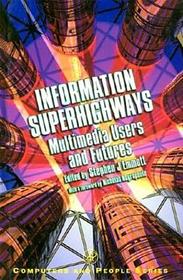
"A global information revolution has begun. Converging communications and computing technologies are forming information superhighways, linking people and information interactively, at any time, in any place, via a combination of multimedia, digital video, sound, graphics, and text.The challenge now is to understand the needs of people as the users of information superhighways and develop products and services that use the technological advances to positive effect. This is the first book to examine these issues. It shows that by focusing on users, a range of multimedia applications emerge which make more imaginative use of computing and bandwidth than the products of the current focus on application development, such as""video on demand.""The book emphasizes the point that the information revolution will be driven by users, not the multimedia industry.Information Superhighways is essential reading for those working in the communications, computing, and media industries, and in multimedia. It will also be of interest to students and practitioners in psychology, computing, and human-computer interaction."
MoreTable of Contents:
Part 1: Overview: S. Emmott, Introduction. Part 2: Issues: P. Cochrane, The Information Wave. R. Mansell, From Telephony to Telematics: Equity, Efficiency and Regulatory Innovation. R. Silverstone, Media, Communication, Information, and the 'Revolution of Everyday Life. W. Dutton, Driving into the Future of Communications? Check the Rearview Mirror. N. Sheehy, Designing Organizations Using Telematic Technologies: Risks and Benefits. Part 3: Applications: J. Tang and E. Isaacs, Studies of Multimedia-Supported Collaboration. C. Heath, P. Luff, and A. Sellen, From Video-Mediated Communication to Technologies for Collaboration: Reconfiguring Media Space. D. Travis, The Electronic Agora. B. Nardi, H. Schwarz, A. Kuchinsky, R. Leichner, S. Whittaker, and R. Sclabassi, Video-as-Data: Turning Away from Talking Heads. V. Bruce, The Role of the Face in Face-to-Face Communication: Implications for Videotelephony. R. Watt, An Examination of the Visual Aspects of Human Facial Gesture. A. Monk, Interdisciplinary Approaches to Multimedia Research. Index.
More
