

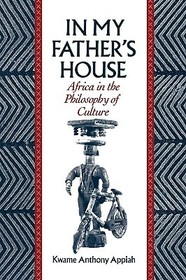
In My Father's House
Africa in the Philosophy of Culture
- Publisher's listprice GBP 25.99
-
11 734 Ft (11 175 Ft + 5% VAT)
The price is estimated because at the time of ordering we do not know what conversion rates will apply to HUF / product currency when the book arrives. In case HUF is weaker, the price increases slightly, in case HUF is stronger, the price goes lower slightly.
- Discount 15% (cc. 0 Ft off)
- Discounted price 9 974 Ft (9 499 Ft + 5% VAT)
- Discount is valid until: 5 August 2026
Subcribe now and take benefit of a favourable price.
Subscribe
11 734 Ft

Availability
printed on demand
Why don't you give exact delivery time?
Delivery time is estimated on our previous experiences. We give estimations only, because we order from outside Hungary, and the delivery time mainly depends on how quickly the publisher supplies the book. Faster or slower deliveries both happen, but we do our best to supply as quickly as possible.
Product details:
- Publisher OUP USA
- Date of Publication 16 June 1994
- ISBN 9780195068528
- Binding Paperback
- No. of pages256 pages
- Size 233x156x18 mm
- Weight 367 g
- Language English 0
Categories
Short description:
In this widely-acclaimed volume, Ghanian philosopher Kwame Anthony Appiah explores, in his words, "the possibilities and pitfalls of an African identity in the late twentieth century." In the process he sheds new light on what it means to be an African-American, on the many preconceptions that have muddled discussions of race, Africa, and Afrocentrism since the end of the nineteenth century, and on much more.
MoreLong description:
The beating of Rodney King and the resulting riots in South Central Los Angeles. The violent clash between Hasidim and African-Americans in Crown Heights. The boats of Haitian refugees being turned away from the Land of Opportunity. These are among the many racially-charged images that have burst across our television screens in the last year alone, images that show that for all our complacent beliefs in a melting-pot society, race is as much of a problem as ever in America.
In this vastly important, widely-acclaimed volume, Kwame Anthony Appiah, a Ghanaian philosopher who now teaches at Harvard, explores, in his words, "the possibilities and pitfalls of an African identity in the late twentieth century." In the process he sheds new light on what it means to be an African-American, on the many preconceptions that have muddled discussions of race, Africa, and Afrocentrism since the end of the nineteenth century, and, in the end, to move beyond the idea of race.
In My Father's House is especially wide-ranging, covering everything from Pan Africanism, to the works of early African-American intellectuals such as Alexander Crummell and W.E.B. Du Bois, to the ways in which African identity influences African literature. In his discussion of the latter subject, Appiah demonstrates how attempts to construct a uniquely African literature have ignored not only the inescapable influences that centuries of contact with the West have imposed, but also the multicultural nature of Africa itself. Emphasizing this last point is Appiah's eloquent title essay which offers a fitting finale to the volume. In a moving first-person account of his father's death and funeral in Ghana, Appiah offers a brilliant metaphor for the tension between Africa's aspirations to modernity and its desire to draw on its ancient cultural roots.
During the Los Angeles riots, Rodney King appeared on television to make his now famous plea: "People, can we all get along?" In this beautiful, elegantly written volume, Appiah steers us along a path toward answering a question of the utmost importance to us all.
A wonderfully crafted collection of essays.

