

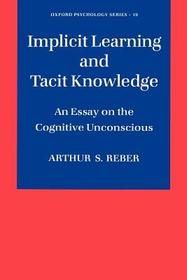
Implicit Learning and Tacit Knowledge
An Essay on the Cognitive Unconscious
Series: Oxford Psychology Series; 19;
- Publisher's listprice GBP 60.00
-
27 090 Ft (25 800 Ft + 5% VAT)
The price is estimated because at the time of ordering we do not know what conversion rates will apply to HUF / product currency when the book arrives. In case HUF is weaker, the price increases slightly, in case HUF is stronger, the price goes lower slightly.
- Discount 10% (cc. 2 709 Ft off)
- Discounted price 24 381 Ft (23 220 Ft + 5% VAT)
Subcribe now and take benefit of a favourable price.
Subscribe
27 090 Ft

Availability
printed on demand
Why don't you give exact delivery time?
Delivery time is estimated on our previous experiences. We give estimations only, because we order from outside Hungary, and the delivery time mainly depends on how quickly the publisher supplies the book. Faster or slower deliveries both happen, but we do our best to supply as quickly as possible.
Product details:
- Publisher OUP USA
- Date of Publication 26 September 1996
- ISBN 9780195106589
- Binding Paperback
- No. of pages200 pages
- Size 157x234x11 mm
- Weight 290 g
- Language English
- Illustrations line figures 0
Categories
Short description:
This book is a highly readable account of the various lines of research which bear on the general problem of implicit, unconscious, nonreflective acquisition of knowledge. Implicit knowledge, a term coined by Reber in 1965, is acquired independent of conscious attempts to learn and generally without the capacity to communicate what has been acquired. One of the core assumptions of this argument is that implicit learning is a fundamental process, one that lies at the very heart of the adaptive behavioral repertoire of every complex organism.
MoreLong description:
Implicit knowledge, a term coined by Reber in 1965, is acquired independent of conscious attempts to learn, and generally without the capacity to communicate what has been acquired. One of the core assumptions of this argument is that implicit learning is a fundamental process, one that lies at the very heart of the adaptive behavioural repertoire of every complex organism. This is a highly readable account of the cognitive unconscious, focusing in particular on the problem of implicit learning.
From reviews of the hardback: "...every psychologist will enjoy reading this book." De Psycholoog
Table of Contents:
Introductory Remarks
On Learning
On Evolution
On Measuring the Contents of Consciousness
On Intelligence and Instruction
A Note on Terminology
A Rapid Historical Overview
Summary
A Personal Aside
Implicit Cognition: The Data Base
The Polarity Fallacy
On the Primacy of the Implicit
On Functionalism
Some Assumptions
Experimental Procedures
Empirical Studies of Implicit Learning
Methodological Issues in Implicit and Explicit Learning
Evolutionary Considerations: The Primacy of the Implicit
Some Introductory Remarks
The Evolutionist's Line
An Evolutionary Context for the Cognitive Unconscious
Hypothesized Characteristics of Implicit Systems
Implicit Issues: Some Extensions and Some Speculations
Implicit Learning and/or Implicit Memory
On Rules
Knowledge Representation
On Consciousness
Prediction and Generation of Events
Nativism and Empiricism
Afterwords
In Summary

