

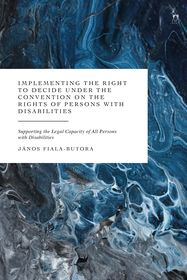
Implementing the Right to Decide under the Convention on the Rights of Persons with Disabilities
Supporting the Legal Capacity of All Persons with Disabilities
- Publisher's listprice GBP 90.00
-
40 635 Ft (38 700 Ft + 5% VAT)
The price is estimated because at the time of ordering we do not know what conversion rates will apply to HUF / product currency when the book arrives. In case HUF is weaker, the price increases slightly, in case HUF is stronger, the price goes lower slightly.
- Discount 10% (cc. 4 064 Ft off)
- Discounted price 36 572 Ft (34 830 Ft + 5% VAT)
Subcribe now and take benefit of a favourable price.
Subscribe
40 635 Ft

Availability
printed on demand
Why don't you give exact delivery time?
Delivery time is estimated on our previous experiences. We give estimations only, because we order from outside Hungary, and the delivery time mainly depends on how quickly the publisher supplies the book. Faster or slower deliveries both happen, but we do our best to supply as quickly as possible.
Product details:
- Publisher Bloomsbury Publishing (UK)
- Date of Publication 2 October 2025
- Number of Volumes Hardback
- ISBN 9781509980321
- Binding Hardback
- No. of pages186 pages
- Size 236x158x16 mm
- Weight 440 g
- Language English 845
Categories
Table of Contents:
Preface
Acknowledgements
Table of Cases
Table of Statutes
Table of International Law Sources
1. Introduction
1.1 The Existing Landscape of Legal Capacity Law
1.2 Recent Challenges to Guardianship
1.3 The Structure of This Book
1.4 Note on Terminology
2. Legal Capacity
2.1 What is Legal Capacity?
2.2 A Historical Overview
2.3 Legal Capacity as a Human Right
2.3.1 Violations of Procedural Rights
2.3.2 Violations of Other Substantive Rights
2.3.3 Guardianship as Such
2.4 Implications for the Convention on the Rights of Persons with Disabilities
3. Interpreting Article 12 of the CRPD
3.1 The Conflicting Views on Interpreting Article 12
3.1.1 The Absolutist Position and the Constricted Position
3.1.2 Strong and Weak Points
3.1.2.1 Support to Persons with Severe Disabilities
3.1.2.2 The Role of Mental Capacity
3.1.2.3 The CPRD's text
3.1.3 Common ground
3.2 The Text of Article 12 - and its Implications
3.2.1 The Consensual Aspect
3.2.2 The Suprapositive Aspect
3.2.3 The Institutional Aspect
3.5 Conclusion - Does Article 12 Resolve the Debate?
4. The Inherent Features of Guardianship
4.1 Is the Aim of Substitute Decision-making Ever Legitimate?
4.2 The Assumptions behind Guardianship
4.3 Different Legal Approaches to Guardianship
4.2.1 The Status Approach
4.2.2 The Quasi-Status Approach
4.2.3 The Outcome Approach
4.2.4 The Functional Approach
4.2.5 The Quasi-functional Approach
4.4 Evaluating the Different Approaches
4.3.1 Costs
4.4.2 Legal Certainty
4.4.3 Protection from Abuse
4.4.4 Ease of Administration and Oversight
4.4.5 Evaluation of the Above Approaches
5. The Alternative: Supported Decision-Making
5.1 What is Supported Decision-Making?
5.1.1 The Emergence of Supported Decision-Making in International Law
5.1.2 Supported Decision-Making in Domestic Laws
5.1.3 The Ideal and Existing Models of Supported Decision-Making
5.2 The Psychological Assumptions behind Supported Decision-Making
5.2.1 Interdependent Decision-Making
5.2.2 The Psychological Basis of Supported Decision-Making
5.2.2.1 Abstract Thinking and Context
5.2.2.2 Logical/Linguistic Intelligence
5.2.2.3 No Support
5.2.2.4 Legal and Clinical Incompetence
5.3 Forms of Supported Decision-Making
5.3.1 Supported Decision-Making as the Natural Way of Making Decisions
5.3.2 Supported Decision-Making as a Principle
5.3.3 Supported Decision-Making as an Alternative to Guardianship
6. Supported Decision-Making as a Legal Institution
6.1 Ideal v Legal Forms of Supported Decision-Making
6.2 The Functions of the Legal Regulation of Supported Decision-Making
6.2.1 The Guardian's Right to be Present and to Access Information
6.2.2 The Role of Supporters
6.2.3 Legal Certainty
6.2.4 Protection from Harmful Decisions
6.2.4.1 Abuse by Others
6.2.4.2 Abuse by Self
6.2.4.3 Abuse by the Supporter
6.3 Comparing Guardianship and Supported Decision-Making
6.3.1 Restrictiveness
6.3.2 Flexibility
6.3.3 The Pedagogic Effect
6.3.4 The Expressive Function
6.3.5 Ease of Transacting
6.3.6 Protection from Harmful Decisions
6.4 Conclusion
7. The Case of Persons with High Support Needs
7.1 Existing Solutions and their Shortcomings
7.1.1 The Support Only Framework - the Complete Abolition of Guardianship
7.1.2 The Some Guardianship Framework - the Need to Make Substituted Decisions
7.1.3 Common Ground and Divergence between the Two Positions
7.2 The Modified Support Framework - a Proposal for a Third Option
7.2.1 Who Are 'Persons with High Support Needs' from a Legal Perspective?
7.2.2 The Modified Support Framework in Practice
7.2.3 Comparing the Three Models
7.3 Safeguards Ensuring that Support Does Not Become Substitution
7.4 The equality of Persons with High Support Needs
8. Conclusion
Bibliography

