

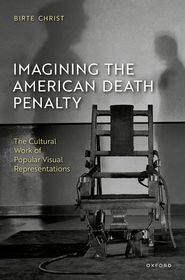
Imagining the American Death Penalty
The Cultural Work of Popular Visual Representations
Series: Law and Literature;
- Publisher's listprice GBP 88.00
-
42 042 Ft (40 040 Ft + 5% VAT)
The price is estimated because at the time of ordering we do not know what conversion rates will apply to HUF / product currency when the book arrives. In case HUF is weaker, the price increases slightly, in case HUF is stronger, the price goes lower slightly.
- Discount 10% (cc. 4 204 Ft off)
- Discounted price 37 838 Ft (36 036 Ft + 5% VAT)
Subcribe now and take benefit of a favourable price.
Subscribe
42 042 Ft

Availability
Estimated delivery time: In stock at the publisher, but not at Prospero's office. Delivery time approx. 3-5 weeks.
Not in stock at Prospero.
Why don't you give exact delivery time?
Delivery time is estimated on our previous experiences. We give estimations only, because we order from outside Hungary, and the delivery time mainly depends on how quickly the publisher supplies the book. Faster or slower deliveries both happen, but we do our best to supply as quickly as possible.
Product details:
- Publisher OUP Oxford
- Date of Publication 31 May 2025
- ISBN 9780198935087
- Binding Hardback
- No. of pages320 pages
- Size 240x164x25 mm
- Weight 630 g
- Language English 616
Categories
Short description:
Imagining the American Death Penalty traces the ways in which US American culture represented capital punishment in film and television from the 1890s to the twenty-first century. The book focuses on early film, crime film noir, and legal TV series.
MoreLong description:
Imagining the American Death Penalty traces the US American cultural imaginary of capital punishment through popular visual representations from the 1890s to the twenty-first century. The book focuses on three generic and historical clusters of representations: early film from the 1890s through Intolerance (1916), crime film noir of the 1950s and1960s, and legal TV series from the 1990s through the early 2000s. The book makes two central arguments. First, it demonstrates that an increased concern with the death penalty in popular media does not mean that these texts promote an abolitionist agenda: their cultural work is ambiguous at best. This ambiguity is always contingent upon both the affordances of the particular genre and medium in question and on political-legal discursive context. The book explores both in detail. Early film is enchanted with its own representational possibilities due to the progress of technology and, in analogy, with the progress in execution technique, specifically the electric chair. In film noir, genre conventions and the legal back-and-forth before and after Furman predicate ambiguity. In legal TV series, the genre's ensemble casts and its focus on conversational exchange invite open debate. The second argument is that popular visual representations consistently whitewash the death penalty. The book demonstrates that this is the case because the most common narrative around executions in film and TV is to cast the condemned man as a hero who defies the violence of the state, gains dignity by accepting his fate and faults, and in some ways triumphs over death. The American imaginary, until very recently, did or could not imagine Black men to possess that measure of agency that it attributed to its white heroes.
MoreTable of Contents:
Introduction: Imagining the American Death Penalty
PART I. THE C AMER A AND THE CHAIR , 1890-1916
New Technologies of Representation and Death
Scenes of Execution
PART II. BL ACK FILM, WHITE FACES
Before Furman
Hollywood's "Mixed Verdict"
PART III. PUTTING DE ATH INTO DISCOURSE
New Abolitionism, New Genre
Multiple Audience Positions in Legal Series
Conclusion: Entertaining Ambiguity, and Imagining New Black Men and Women

