

- Publisher's listprice GBP 20.99
-
10 027 Ft (9 550 Ft + 5% VAT)
The price is estimated because at the time of ordering we do not know what conversion rates will apply to HUF / product currency when the book arrives. In case HUF is weaker, the price increases slightly, in case HUF is stronger, the price goes lower slightly.
- Discount 10% (cc. 1 003 Ft off)
- Discounted price 9 025 Ft (8 595 Ft + 5% VAT)
Subcribe now and take benefit of a favourable price.
Subscribe
10 027 Ft

Availability
Estimated delivery time: In stock at the publisher, but not at Prospero's office. Delivery time approx. 3-5 weeks.
Not in stock at Prospero.
Why don't you give exact delivery time?
Delivery time is estimated on our previous experiences. We give estimations only, because we order from outside Hungary, and the delivery time mainly depends on how quickly the publisher supplies the book. Faster or slower deliveries both happen, but we do our best to supply as quickly as possible.
Product details:
- Publisher Indiana University Press
- Date of Publication 26 December 2016
- Number of Volumes Print PDF
- ISBN 9780253022677
- Binding Paperback
- No. of pages364 pages
- Size 229x216 mm
- Weight 1202 g
- Language English
- Illustrations 118 color illus. Halftones, color 0
Categories
Long description:
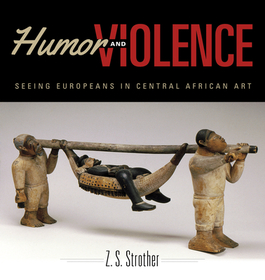
Humor and Violence examines the rich history of portraying Europeans in Central African art in images ranging from heart-wrenching scenes of human trafficking to playful parodies of colonialists. Z. S. Strother contends that the dialectic of humor and violence reveals deep insights into the psychology of power and resistance that continues to operate in the region today. Her argument is built on a set of works of art and demonstrates the important role that patronage and political and social history played in their creation. Strother conveys Central African ideas about how the therapeutic power of humor can initiate social change and upset power relations between oppressors and oppressed. This analysis plunges seemingly benign figures into a maelstrom of violence and crime–rape, murder, torture, and forced labor on a massive scale. By restoring the dialectic of humor, it reveals the complicated psychological codependency of Africans and Europeans over a long period of history and maintains that art plays a mediating function in the mechanics and ethics of power.
MoreTable of Contents:
Acknowledgments
Preface
1. Introduction
2. Warning! What do you see? A white man? Or an over-dressed one?
3. New Commodities on the Loango Coast (1840-1880)
4. Depictions of Human Trafficking on Loango Ivories in the 1880s
5. Humor in the Hygiene of Power (ca. 1885-1915)
6. By Congolese, for Congolese (1910s-40s)
7. The African Victim in the Congolese Imaginary (1950s-1997)
Coda: Congolese Perspectives on Humor and Redemption
Notes
Bibliography
Index

